Slide Show of Plane Geometry/Constellations Preserved on the Phaistos Disk
Revealed by Connecting Matching Pictographs with Lines
|
OH MY GOD, IT'S FULL OF STARS
"The thing's hollow! It goes on forever..." Well, it has gone on for seventeen years, for me anyway, and it sort of seems like forever. The Phaistos Disk, a 1,700 BCE space odyssey in its own right, is an ancient artifact nearly 4,000 years old. But recently an archaeologist claimed the Phaistos Disk to be a hoax, and he also claimed to be an authority on art hoaxes. I take this opportunity to defend the Phaistos Disk and its discoverer.
IS THE PHAISTOS DISK A HOAX?
(a) - He published this theory as an article in a magazine he funds himself. The magazine contains archaeology articles and
advertisements for antique furniture that he owns.
(b) - He claims Pernier, who discovered the disk in 1908, was motivated to create it and plant it there because he was
jealous of Sir Arthur Evans' fame.
(c) - Pernier, the discoverer of the Phaistos Disk, is dead and cannot defend himself, nor has anything ever been
written or recorded to indicate Pernier did anything wrong.
(d) - He seeks to create a debate in London at the Society of Antiqueries as to whether it is a forgery.
(e) - He chooses who will debate his theory that the disk is a forgery.
(f) - He has invited as a keynote speaker another archaeologist who is an expert in Aegean scripts.
(g) - When I offered, by email, to appear at the debate and defend Pernier and disprove the forgery theory,
I have so far received no response. I do not expect to receive an invitation. Therefore, the following is my debate. (h) - Less than a day after I first published this web page, I received this email response.
Dear Ms. Watson,
Please excuse my delay in answering your very interesting e-mail as I have been inundated with e-mail correspondence.
I would certainly be interested in receiving your abstract for either an oral or poster presentation for the Conference provided it is
[sic] basically consists of new and original ideas beyond your Minoan wave spiral concept and not something that you have already
published on your website (which I have made reference to in my article).
I look forward to your reply and to the possibility that you might attend the Conference.
Cordially,
Jerome M. Eisenberg. Ph.D.
Editor-in-Chief, Minerva,
The International Review of Ancient Art & Archaeology,
and
Chairman, International Conference on the Phaistos Disk
I have intensively researched the Phaistos Disk for seventeen years and I believe it is an authentic Minoan artifact.
I also believe that the man who created this hoax theory is motivated to draw attention to himself, to sell subscriptions to his magazine
and to create more advertising revenue for his advertisers. I suggest it is not Pernier who was jealous of Evans but the hoaxologist who
is jealous of Pernier for achieving something remarkable in archaeology. Eisenberg has no qualms in destroying Pernier's good name and
reputation in order to sell subscriptions and furniture. He may call his scheduled event the International Conference on the Phaistos Disk,
but he certainly has no intentions of holding a serious debate on the Phaistos Disk suitable to the antiquarian society.
The Society of Antiqueries in London is centuries-old and is a respected forum for debate, but Eisenberg does not hesitate to
use this society to commercialize himself. The original concept of the debate was one of scholarship and not commercialism. The Society
should halt this conference, or remove him from control of who will attend, and take control of it themselves, so that at the center of the
debate is the Phaistos Disk. The debate should include anyone who has original material to present in debating this hoax theory, which also
entails defending Pernier and his good name. If only linguists and scriptologists attend, then no meaningful debate can be expected that
would disprove the hoaxologist's theory, as the Phaistos Disk contains a one-off script, if it really is a script at all.
HERE IS WHAT HE DOES NOT WANT ME TO PRESENT AT HIS HOAX CONFERENCE AS IT WOULD DISPROVE HIS HOAX THEORY
My work on the Phaistos Disk has been published for many years and while it may not conclusively prove what the Phaistos Disk is
all about, it certainly proves conclusively that this artifact cannot possibly be a forgery, and for several reasons.
(1) - The Phaistos Disk is remarkable no matter when it was created. Even today, this would be an amazing creation by a ceramics artist.
But in 1908 when it was discovered not enough was known about this civilization, or even this period of time, by any artist or archaeologist anywhere
to create this pottery art masterpiece that so perfectly aligns itself with what we now know about the Minoan Civilization.
(2) - Even if you could present a good argument that this incredible artifact could be created by someone in 1908, you could hardly
argue effectively that the artist who created it would be satisfied to remain forever anonymous, with not even a death bed confession.
(3) - Even an archaeologist overcome with jealously could still reason that the discovery of one significant artifact could never
outweigh the discovery by Evans of an entire lost civilization.
(4) - A scientific test that would destroy part of the artifact is not even necessary. Just a look at the eight hidden patterns
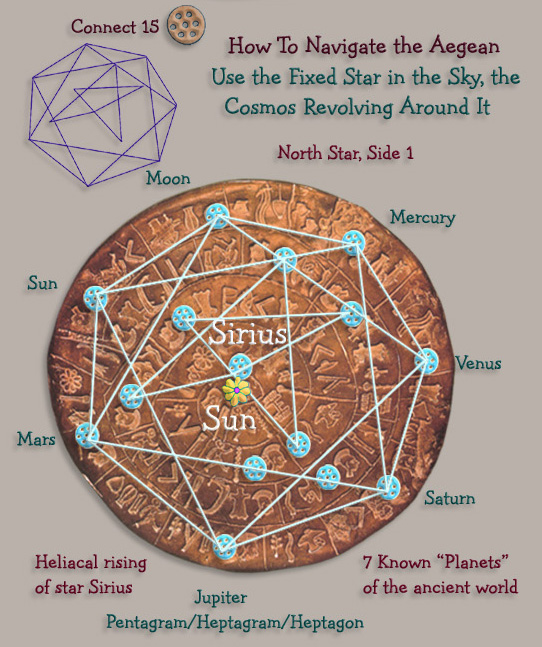
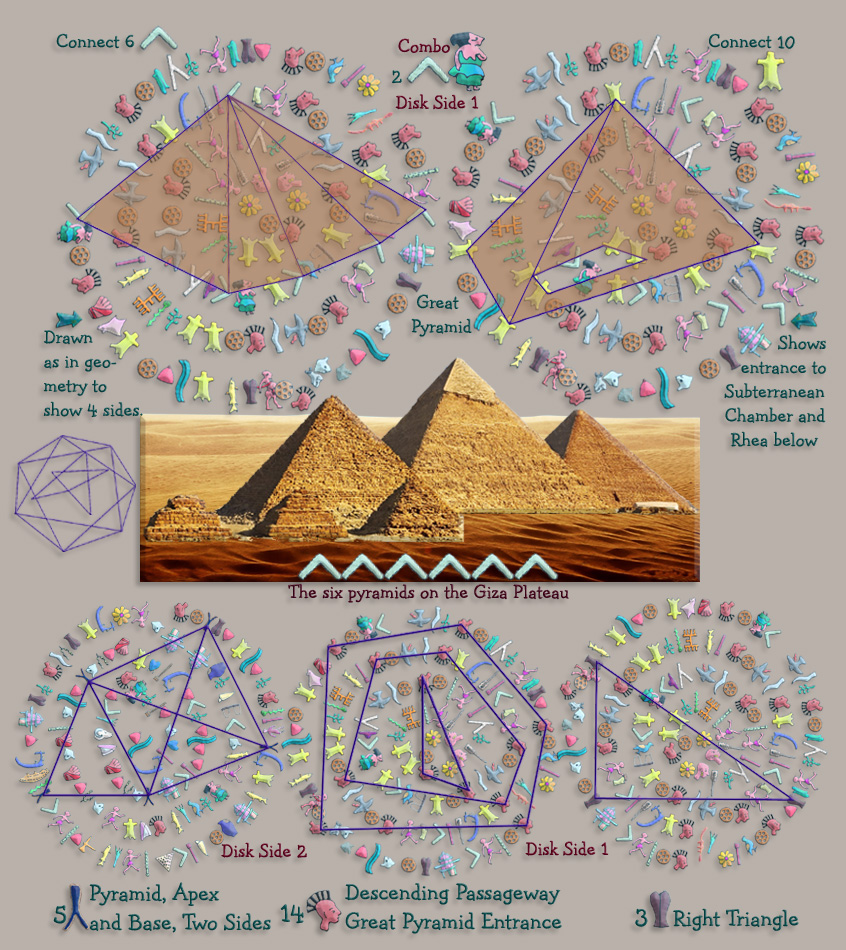
on the disk will prove its authenticity. They are: a Minoan wave spiral; a Minoan figure 8 shield; a star inside a heptagon which could be the
star Sirius surrounded by the seven planets; a perfect image of the constellation Argo; an interior view of a pyramid; an exterior view of a
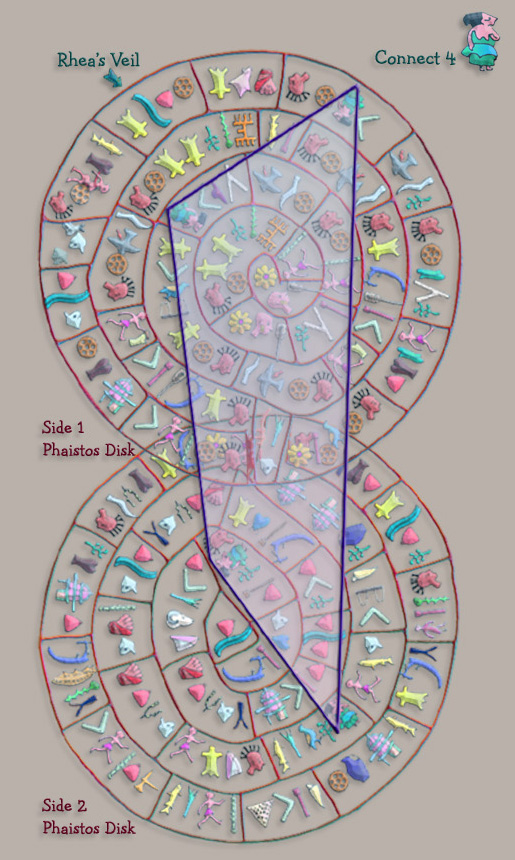
pyramid that could be the Great Pyramid; and an image that might be the sacred cave where telescope lenses were discovered that are now on
display in a museum in Crete.
(5) - A debate worthy of the Society of Antiqueries in London would be how significant these images could be in establishing
a theory of Minoan astronomy. This of course does not further the agenda of the hoaxologist, but it does acknowledge Pernier in his significant
discovery and it lends a great deal of credence to recent theories by archaeologists G. Henriksson and M. Blomberg who write:
We argue from these results (astronomical orientation of the palaces of Crete) that the Minoans had begun
systematic observations of the sun, the moon and the bright star Arcturus by the end of the Early Minoan Period (ca 2000 BC). The proximity
of Crete to Egypt and the Near East and the documented contact among these regions invite comparison of the calendrical uses of astronomical
knowledge in the three areas in the Bronze Age.
In conclusion, the Phaistos Disk hoax theory is not sound and is even dangerous because it threatens to derail the
possibility of significant research into the area of Minoan astronomy. More important than selling antique furniture is to discuss
whether the Minoans were astronomers in their own right. A look at the Phaistos Disk and these eight patterns might justify the
funding of more research into this area of archaeoastronomy.

Phaistos Disk Side 1

Phaistos Disk Side 2
PHAISTOS DISK TRACINGS BY ME
THE PICTOGRAPHS THAT ARE REPEATED ON THE PHAISTOS DISK
APPEAR TO BE IDENTICAL
I CONNECTED THESE IDENTICAL PICTOGRAPHS WITH LINES LIKE CONNECT-THE-DOTS
Leaving none out and adding nothing
To Find These Images Hidden in Plain Sight
As you can see, this man is holding the disk as a shield at his belt. The Phaistos Disk may be a template for a
Bronze Age shield, perhaps the legendary shield that became known later on in history as Shield of Achilles. Or there is the possibility this
indicates stars in constellation Orion, such as Orions's Belt. Could this be a protypical Zeus holding the Disk of the World?
Whatever it may be, this pottery art masterpiece contains a beautiful artistic design that, when colorized and animated,
seems modern and not at all 3,600 years old. Does this indicate the Minoans believed the Star Sirius, the mother Isis/Rhea, is shielding us? This is, perhaps, an image of our planetary shield.
Drag me! I think the Phaistos Disk was created by early Egyptian and Minoan astronomers.

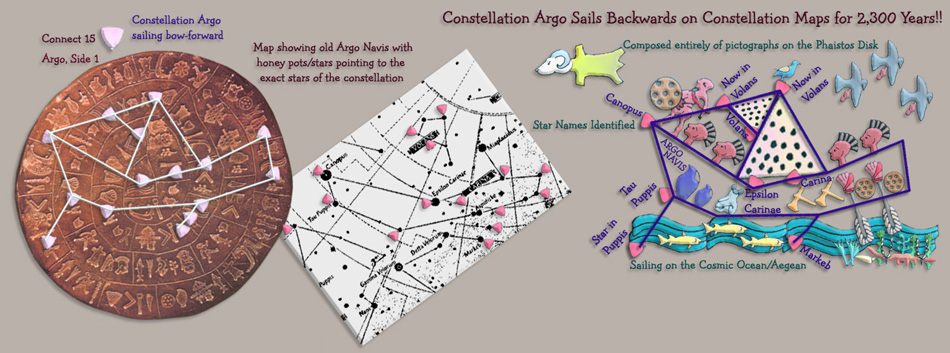
In this Phaistos Disk image of the picture perfect constellation Argo, the sails are a great pyramid that
sit atop the boat. This makes me wonder if the Egyptians conceived of the idea of the Great Pyramid as being in the sky and sailing along as
part of the Constellation Argo. That would help to explain the presence
of the boat at the Great Pyramid. Could the pharaoh have believed that the Great Pyramid would be his house afterdeath and that his
house would be taken up with him in it, at least in spirit, along with his entourage to Osiris, to sail with the god in his barque?
The constellation was also known as Barque of Osiris, that which conveyed the god Osiris through the heavens.
Through a transformation of myth, this became the Greek legend of Jason and the Argonauts who sailed across the heavens in the Argo as they
searched for the Golden Fleece (left, pictograph on the disk).

The next two images on the disk, interior and exterior views of the Great Pyramid, tend to confirm the above
ideas regarding the boat, the pyramid and the stars.


MINOAN WAVE SPIRAL AND MINOAN FIGURE 8 SHIELD
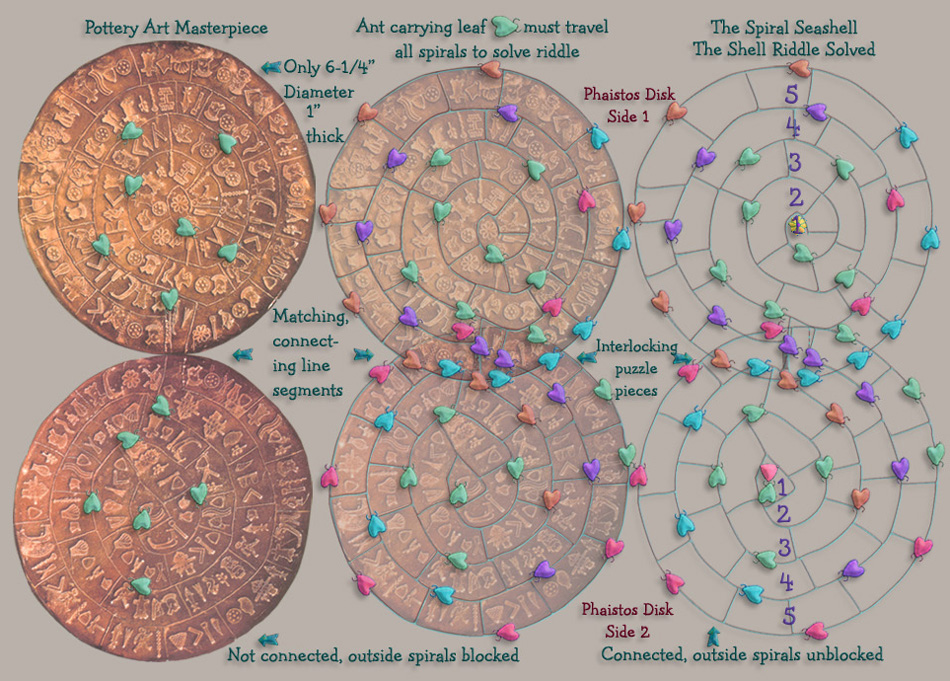
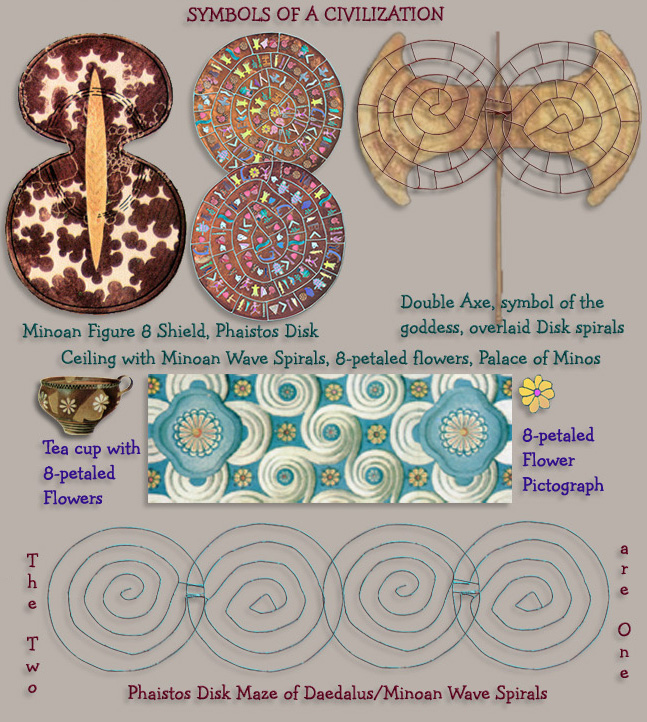
Left is a vase from Knossos dated 1500 BCE that displays Figure 8 Shields. The top of the vase is ringed with disks. Beside this vase is the same vase onto which I have super-imposed the Phaistos Disk, its two sides placed side-by-side, the connecting line segment highlighted.
The shields on the original vase appear to be composed of two disks. Each disk is filled with dots that might represent pictographs on the Phaistos Disk, and the disks are joined by a connecting line path. I wonder if the artist who made the Phaistos Disk also made this vase? If not, then perhaps this design, so carefully preserved by the Phaistos Disk, represents a legendary shield or maybe it represents the Phaistos Disk itself.
Below is the Phaistos Disk that I traced as exactly as I could and then created .gif transparancies of the disk. I added a drag and drop script to this
web page so that these two images are dragable. The two sides of the Phaistos Disk,
placed side-by-side this way, appear to be a type of maze.
HOW DO YOU SOLVE A MAZE?
The solution to a maze is the
uninterrupted path through an intricate pattern of line segments from a starting point to a goal.
The disk has a combined sixty line segments and two large spirals, each with five levels.
The starting point of this maze is the center of Side A (top disk with flower at the center),
the goal is the center of Side B (bottom disk with wave at the center). To solve the maze,
find the uninterrupted path through the line segments of all the spirals, from A to B and back.
OUT OF THE LOOP? SOLVE THE PHAISTOS DISK MAZE AND GET BACK IN

I believe the Phaistos Disk is a Bronze Age record of the ancient religion we now call Hermeticism. One side of the disk is Ba and the other side is Ka. Joining them together at the connecting line segments producs La, or the union of Ka and Ba. This union creates immortality represented by infinity or the figure 8. We see this figure 8 represented in art throughout the Minoan civilization, especially in their Figure 8 Shields. This entire civilization, like the Maya, considered themselves to be immortal.
Before reading the solution, notice that the images above are dragable and take a clue from this Phaistos Disk pictograph of a bald man
with the figure 8 on his cheek (astronomer-priest). An astronomer-priest would know about infinity.
The Minoan wave spirals (see below) are created by moving from the center of Side A and
crossing over to the center of Side B and back via the 4th level spirals on both sides. The matching
connecting line segments direct the movement from Side A to Side B but also prevent travel in the outer
spirals on either side. To see the Minoan Figure 8 shield and incorporate those spirals, merge the two
sides of the disk by overlaying the perfectly aligned connecting line segments. To achieve this, drag
the bottom image onto the top image and overlay the connecting line segments. Now all the spirals are
connected and the movement of the figure 8 shield is discovered.
Start at the center of Side A and trace the spiral around to the 4th level, cross over
to the outer spiral on Side B, cross from that outer spiral to the outer spiral on Side A, cross from the
outer spiral on Side A into the 4th spiral on Side B and travel to the center. Then make the same journey
in reverse, each time creating the movement of a figure 8.
Pattern #6 (left, Minoan Wave Spiral) and #7
(middle, Minoan Figure 8 Shield)
To emphasize the spirals, I erased the pictographs from the disk, leaving only the spirals
and line segments. Then I placed the two sides together at the matching line segments.
Wave spirals and Figure 8 shields in the art of Minoan Crete.
Now you can see how to start at the center of side 1, the side with the flower in the center,
and trace the spiral around to the 4th level, cross over to the outer spiral on side 2, cross from that outer
spiral to the outer spiral on side 1, cross from the outer spiral on side 1 into the 4th spiral on side 2 and
travel to the center. Then make the same journey in reverse, each time creating the movement of a figure 8.
The two sides of the disk connected create a flowing figure 8 wave spiral that
moves uninterrupted from the center of one side of the disk to the other and back again and incorporates
all parts of the spiral. In the horizontal position, it creates a Minoan wave spiral. In the vertical position,
it creates a Minoan figure 8 shield (right). (Left, Minoan pottery with
geometric orientation - wave spirals and figure 8 shields.)
Click to see Minoan wave spirals ceiling design with 8-petaled flower at the center
(as seen on Side 1 of the Phaistos Disk).

PATTERN #8 - PHAISTOS DISK PATTERNS COMPLETE THE HOLY TRINITY OF EARLY ASTRONOMY - SIRIUS, ARGO NAVIS, THE PLEIADES
According to ancient beliefs, the axis of the universe is the Pleiades in Taurus. The idea is that our bodies are somehow intimately connected to a point far away in space, in the Taurus constellation of the bull. Did these astronomers use the lion to create an image on the Phaistos Disk of the Pleiades?
If they did, perhaps it comes from the Egyptian lion goddess Sekhmet, the inference being the Pleiades are goddesses.
We know the Pleiades as the Seven Sisters but perhaps the Egyptians and Minoans deified them so they were the
seven goddesses, or eight goddesses as there are eight lions on this side of the disk. The Pleiades on the
Phaistos Disk completes the ancient astronomy holy trinity of Sirius, Argo Navis, and Pleiades.
This nearly identical image of the constellation Taurus is revealed on the Phaistos Disk when these eleven walker pictographs are connected with lines.
...in those days [of ancient Egypt] of initiate kings and rulers and sages who occupied themselves with the Sacred Science,
when the clear Aether spake face to face with them without disguise, or holding back aught, in answer to their deep scrutiny of holy things...In those
days so great was their love of the holy mysteries, so high their virtue, that they left the earth below them, and in their deathless souls
became 'heaven-walkers' and knowers of things divine. (Thrice-Greatest Hermes, G.R.S. Mead)

HOW THE DISK WAS MADE - THE GOD KHNUM-RA
In ancient Egypt the god Khnum, one of the earliest gods, made the Ba or human bodies of children from clay on his potter's wheel. He also placed them in their mother' womb. This accounted for the origin of the human body of an individual, which came from out of this god. He was the consort of Heket, who breathed life into the children at birth. He was also thought of as the creator of other gods, so he became identified as the Ba of Ra, the human counterpart of the higher divine self or Ka. Ba was also the world for Ram (left, Phaistos Disk pictograph). The creator of the Phaistos Disk was perhaps re-enacting the work of Khnum-Ra when at the potter's wheel creating the disk.

Phaistos Disk, Side One

Phaistos Disk, Side Two
As you can see, the pictographs on the disk appear to be identical. As example, the shields (left)
that appear fifteen times on this side of the disk are clearly intended to be identical. The same is true for all the pictographs that are
apparently identical. Therefore, an assumption was made and widely accepted by all who study the disk that the pictographs were made with
tiny stamps pressed into the clay disk. This would also conveniently account for raised pictographs on the disk. As they were stamped into the wet clay, the pictographs were
created raised above the disk, making the disk itself into a kind of stamp.
In many cases the pictographs are both raised above the disk and merged with it. In some cases they appear to be pressed into it.
Still, how else could the pictographs be elevated above the disk in such a way and how else could the pictographs be made to be identical? The answer has
to be use of an early printing press technology in the form of tiny pre-made stamps. But this theory, accepted for so many years by so many people, is incorrect.
The printing press theory of using tiny stamps to the create the disk is incorrect.
Nor did the stamp theory ever explain the presence of the elevated spirals on both sides of
the disk. The pictographs left, cropped from an enlarged bmp image of the disk, show the pictographs were intended by its creater to be
identical but are not absolutely identical because the disk creator lacked the rudimentary printing press technology that has long been ascribed to the creation of the Phaistos Disk.
 As the
disk is only a little larger than a CD, the pictographs on the disk are tiny. When these two pictographs are reduced to a size that might appear on the disk, they do become "identical." But when
they are enlarged they are obviously the same but not identical.
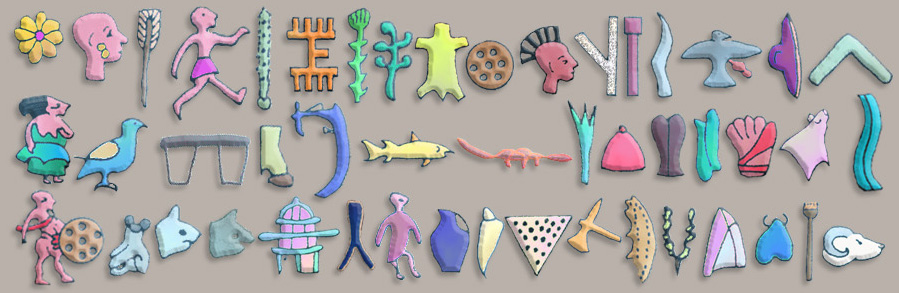
 I cropped all the pictographs on the disk and displayed them so you can see that not a single one of them is identical to another. Obviously, a very good artist created these pictographs and this disk (see the table below). Only a good artist working in the genre of miniature art could create 240 individual pictographs to appear to be identical. It is very likely the artist excelled in the genre of miniature art during the Minoan period when art miniaturization was so popular.
 Miniature art in Minoan Crete included statues, figurines, ritual groups (below, left), incense burners, housewares, signet rings, shrine figurines, miniature goddesses, wagons (left), swings (right), shields, dresses, hats, hut urns (below) and much more.
So, the artist created 240 individual miniature pictographs. How did the artist get them onto the disk and why do the pictographs need to be identical? If an artist is making 240
pictographs to go onto a disk, then why would not the artist create unique pictographs? Eleven of the pictographs on the disk are unique. Why hand-create 229 pictographs to look exactly like other
pictographs? If the disk was intended to contain a language script, why not etch that script into the disk rather than make so many tiny pictographs? But it seems the artist wanted to make identical miniature pictographs.
If the artist had the idea and the knowledge to create unique stamps, then obviously s/he would have done so, if for no other reason than to make the pictographs truly identical and
also to save a monumental amount of time. Therefore, printing press technology in the form of tiny stamps into clay was not known at this time or, if it was known, this particular artist did not know it.
There is also the possiblity that the stamp technology was known but did not work well impressed into clay.
So how was it made? Here is my theory. The artist of the Phaistos Disk made at least 10 to 20 sketches of the disk designs prior to creating it. Perhaps the sketches were made using
papyrus or perhaps they were simply drawn into sand. Maybe they were created as other Phaistos Disks but did not come out right so were destroyed and the attempts continued until this disk was
finally created satisfactorily to the artist. Below are the five main sketches made the artist prior to creating the Phaistos Disk.
Additional sketches were made to incorporate into the disk all known figures of plane geometry, including straight parallel lines and straight lines not parallel. (See the right columns.) After the artist made the sketches, s/he created the 240 miniature pictographs from clay and set them aside. Then the round disk was created from the same batch of clay and then the artist lightly etched the spiral designs into both sides of the wet clay disk. Next, the artist pressed the pictographs onto one side of the disk in exact locations, following the pre-made sketches. When one side of the disk was finished it was turned over and laid down so those pictographs were pressed into the wet clay as the other side was being completed. Then the disk was turned again to lay on the second side and press those pictographs into the clay. The artist then made fine lines of clay for the spirals and placed them onto the disk one side at a time along the patterns already etched into the disk.
Alternately, the artist may have created a way to elevate the disk while working on it. Depending on the wetness of the clay disk, the artist had a time frame to create it of probably two to 8 hours. This method of creating the disk also explains why the artist baked it rather than sun dried it, as baking it would ensure the pictographs were permanently merged with the clay disk. In the process of making the disk, many of the pictographs were unevenly merged into the disk and a close inspection of the disk shows smudging, particularly around the outer edges, indicating the disk may have taken some damage during this process or either the method of holding the disk upright left smudges along the edges. This method of making the Phaistos Disk seems very likely to me, especially since I have an idea of why the artist needed the pictographs to seem identical.
The Phaistos Disk is a pottery art masterpiece and is, at the very least, an artist's triumph in the genre of miniaturization. Not only the pictographs are miniatures but also the disk itself is intended, I believe, to be a miniature Figure 8 Shield. Each side of the disk is a face of the shield, upper and lower, and on both faces are more designs so that the Figure 8 Shield itself is a world disk in miniature. The Phaistos Disk may have been intended as a shield design to create a shield. (Left, pictograph of the warrior holding the disk/shield)
PHAISTOS DISK CLAY PICTOGRAPHS
With Locations on the Disk
Line segments are counted from the center of each side, spiraling out
These images are cropped from the disk. Each set of images are the same in that they are intended to be identical,
but they are not identical. They were not made with tiny stamps but created by an artist so accomplished at minature art that we believed
them to be exactly identical as though made by a printing press technology. The artist needed them to seem identical so the connect-the-dots method of solving the disk puzzle could be accomplished.
4Sun/Flower, Helios, Eight, Vertex, Dodona
3 Side A, Positions - 1, 13, 76, Segments - A1, 4, 19 1 Side B, Position - 72, Segment - B19 |
2
Astronomer-Priest, Argonaut, Sailor, Minyae, Oracle, Divine Curete
2 Side A, Positions - 2, 14, Segments - A1, 4 0 Side B |
4
Oar, Argonauts, Minyae, Minyaens
4 Side A, Positions - 3, 15, 46, 71, Segments - A1, 4, 11, 18 0 Side B |
11
Runner, Olympic Runner, Herakles, Hermes
6 Side A, Positions - 4, 19, 41, 66, 84, 118, Segments - A2, 6, 10, 17, 20, 30
5 Side B, Position - 51, 60, 71, 88, 94, Segment - B14, 16, 19, 23, 24 |
6
Spindle for Cloth
3 Side A, Positions - 5, 20, 119, Segments - A2, 6, 30
3 Side B, Position - 44, 89, 95, Segment - B12, 23, 24 |
2
Maze, Palace, House of the God, Three
2 Side A, Positions - 6, 56, Segments - A3, 15
0 Side B |
4
Thistle, Thyrsoi, Festival, Wand with Pine Cone
2 Side A, Positions - 7, 57, Segments - A3, 15
2 Side B, Position - 85, 109, Segment - B22, 28 |
11
Tree, Sacred Oak, Plant, Five
5 Side A, Positions - 8, 16, 57, 85, 90 , Segments - A3, 5, 15, 21, 22
6 Side B, Positions - 9, 29, 58, 66, 79, 111, Segments - B3, 8, 15, 18, 21, 29 |
15
Golden Fleece
10 Side A, Positions - 9, 10, 30, 34, 47, 58, 59, 72, 99, 103, Segments - A3, 3, 9, 9, 12, 15, 15, 19, 24, 25
5 Side B, Positions - 35, 52, 74, 104, 114, Segments - B9, 14, 19, 27, 29 |
17
Bronze Shield, Hexagram, Hexahedron
15 Side A, Positions - 11, 21, 23, 35, 39, 51, 60, 64, 79, 88, 95, 100, 106, 114, 120,
Segments - A3, 6, 7, 9, 10, 13, 15, 16, 19, 21, 23, 25, 26, 29, 30
2 Side B, Positions - 100, 118, Segments - B26, 30 |
19
Minyae, Headdress, Crested Dancer, Armed Dancer
14 Side A, Positions - 12, 22, 36, 40, 48, 52, 61, 65, 73, 80, 89, 96, 107, 121,
Segments - A3, 6, 9, 10, 12, 13, 15, 16, 18, 19, 21, 23, 26, 30
5 Side B, Positions - 11, 54, 78, 110, 119, Segments - B3, 14, 20, 28, 30 |
3
Crossroad, Paved Road, Adjacent Angle
3 Side A, Positions - 17, 26, 86, Segments - A5, 9, 21 |
9
Pillar, Hammer, Awl, Carpentry, Leatherworking
5 Side A, Positions - 18, 44, 53, 69, 77, Segments - A5, 12, 14, 18, 19, 4
Side B, Positions - 4, 24, 98, 108, Segments - B2, 6, 25, 26 |
6
Horn, Serpent, Fire, Rising
5 Side A, Positions - 24, 37, 49, 62, 91 , Segments - A7, 10, 13, 16, 22
1 Side B, Positions - 77, Segments - B20 |
5
Vulture, Icarus
5 Side A, Positions - 25, 38, 50, 63, 92, Segments - A7, 10, 13, 16, 22
0 Side B |
1
Hat, Hill, Pyramid, Mt. Ida
1 Side A, Positions - 27, Segments - A8
0 Side B |
12
Pyramid, Vault
6 Side A, Positions - 28, 31, 43, 68, 93, 117, Segments - A8, 9, 12, 18, 23, 30
6 Side B, Positions - 13, 23, 30, 63, 87, 97, Segments - 4, 6, 8, 17, 23, 25 |
4
Mother, Isis/Rhea, Earth Mother
2 Side A, Positions - 29, 94, Segments - A8, 23
2 Side B, Positions - 10, 59, Segments - B3, 15 |
3
Falcon on the Perch, Bird, Partridge, Dove
2 Side A, Positions - 32, 78, Segments - A9, 19
1 Side B, Positions - 57 , Segments - B15 |
2
 >
Yoke
1 Side A, Positions - 33, Segments - A9
1 Side B, Positions - 64 , Segments - B17 |
2
Hoof, Bull's Foot
2 Side A, Positions - 42, 67, Segments - A11, 17 |
7
Boat, Skiff
2 Side A, Positions - 46, 71, Segments - A12, 18
5 Side B, Positions - 3, 32, 73, 83, 105, Segments - B2, 9, 19, 22, 27 |
6
Sharpsnout Fish
2 Side A, Positions - 54, 90, Segments - A14, 26
4 Side B, Positions - 55, 61, 92, 103, Segments - B15, 16, 24, 26 |
1
Crab
1 Side A, Positions - 74, Segments - B18
0 Side B |
4
Grass, Marshes
1 Side A, Positions - 75, Segments - B18
3 Side B, Positions - 14, 56, 93 , Segments - B4, 15, 24 |
18
Star/Seed, Pomegranate, Fruit, Star
3 Side A, Positions - 79, 87, 97, Segments - A20, 25, 28
15 Side B, Positions - 1, 7, 12, 18, 25, 26, 28, 31, 37, 41, 48, 82, 90, 112, 115,
Segments - B1, 3, 4, 5, 6, 7, 7, 8, 10, 11, 13, 21, 23, 29, 30 |
6

Casket, Coffin Chest
1 Side A, Positions - 82, 105, 115, Segments - A24
3 Side B, Positions - 75, 80, 118 , Segments - B20, 21, 30 |
2
Roll Up, Baby, Rock wrapped as a baby
2 Side A, Positions - 81, 85, Segments - A20, 21
0 Side B |
5
Fingers, Dactyls, 5 Divine Curetes, Hand
1 Side A, Positions - 97, Segments - A24
4 Side B, Positions - 17, 36, 45, 47, Segments - B5, 10, 12, 12, 13 |
1
Pig, Sow
1 Side A, Positions - 98, Segments - A24
0 Side B |
6
Wave, Water, Aegean Sea
2 Side A, Positions - 102, 112 , Segments - A25, 28
4 Side B, Positions - 2, 27, 42, 113 , Segments - B1, 7, 11, 29 |
1
Father, Warrior, Dactyloi, Orion with the Pleiades hanging from the belt, Ares, Planet Mars
1 Side A, Positions - 106, Segments - A26
0 Side B |
1
Dog Scratching, Big Dog, Canis Major
1 Side A, Positions - 108, Segments - A27
0 Side B |
10
Lioness
2 Side A, Positions - 109, 112, Segments - A27, 28
8 Side B, Positions - 6, 20, 39, 43, 46, 50, 62, 70 , Segments - B2, 5, 10, 11,12,13, 16, 18 |
1
Lion Roar
1 Side A, Positions - 110, Segments - A27
0 Side B |
6
Palenquin, Temple
1 Side A, Positions - 116, Segments - A29
5 Side B, Positions - 22, 68, 69, 81, 102 , Segments - B6, 18, 18, 21, 26 |
2
Ivy, Heart of Dionysis
0 Side A, 2 Side B, Positions - 5, 34, Segments - B2, 9 |
2
Hoe, Scepter
0 Side A, 2 Side B, Positions - 8, 33, Segments - B3, 9 |
1
Ram
0 Side A, 1 Side B, Positions - 15, Segments - A4
|
2
Cave, Mystery, Hood of a Robe
0 Side A, 2 Side B, Positions - 16, 53, Segments - B4, 14 |
4
Plant, Olive Branch
0 Side A, 4 Side B, Positions - 19, 38, 49, 76, Segments - B5, 10, 13, 20 |
5
Gauge, Measuring Device, Fork, Horned Serpent
5 Side B, Positions - 21, 40, 86, 106, 117, Segments - B5, 10, 22, 27, 30 |
2
Shell, Trumpet
0 Side A, 2 Side B, Positions - 65, 99, Segments - B17, 24 |
2
Pitcher, Vase
0 Side A, 2 Side B, Positions - 67, 101, Segments - B18, 26 |
1
Saw
0 Side A
1 Side B, Positions - 84, Segments - B22 |
1
Axe, Labrys
0 Side A, 1 Side B, Positions - 91, Segments - B22 |
1
Pyramid, Equilateral, Triangle
0 Side A, 1 Side B, Positions - 96, Segments - B23 |
1
Young Man, Child, Mythical Creature
0 Side A
1 Side B, Positions - 107, Segments - B28 |
|
| |
|
PHAISTOS DISK
Pictographs
1.
|
| 2.
|
| 3.
|
| 4. |
| 5. |
| 6. |
| 7. |
| 8. |
| 9. |
| 10. |
| 11. |
| 12. |
|
| 13. |
| 14. |
| 15. |
| 16. |
| 17. |
| 18. |
| 19. |
| 20. |
| 21. |
| 22. |
| 23. |
| 24. |
| 25. |
| 26. |
| 27. |
| 28. |
| 29. |
| 30. |
| 31. |
| 32. |
| 33. |
| 34. |
| 35. |
| 36. |
| 37. |
| 38. |
| 39. |
| 40. |
| 41. |
| 42. |
| 43. |
| 44. |
| 45. |
| 46. |
| 47. |
| 48. |
|
Phaistos Disk Pictographs
Identical Pictographs are connected with Lines to Reveal the Geometry in the left Column
|
| 1.
|
| 2.
|
| 3.
|
| 4. |
| 5. |
| 6. |
| 7. |
| 8. |
| 9. |
| 10. |
| 11. |
| 12. |
| 13. |
| 14. |
| 15. |
| 16. |
| 17. |
| 18. |
|
| 19. |
| 20. |
| 21. |
| 22. |
| 23. |
| 24. |
| 25. |
| 26. |
| 27. |
| 28. |
| 29. |
| 30. |
| 31. |
| 32. |
| 33. |
| 34. |
| 35. |
| 36. |
| 37. |
| 38. |
| 39. |
| 40. |
| 41. |
| 42. |
| 43. |
| 44. |
| 45. |
| 46. |
| 47. |
| 48. |
23.
Diameter
|
24.
Points Connected by a Line
|
25.
Points Connected by a Line
|
26.
Points Connected by a Line
|
27.
Points Connected by a Line
|
28.
Points Connected by a Line
|
29.
Straight Lines not Parallel
|
30.
Straight Lines not Parallel
|
31.
Right Triangle
Click to see this
interesting animation.
|
32.
Isosceles Triangle
|
33.
Acute Triangle
|
34.
Acute Triangle
|
35.
Scalene Triangle
|
36.
Obtuse Triangle
|
37.
Obtuse Triangle |
|