INTERSTELLAR FLIGHT PORTALS
|
|
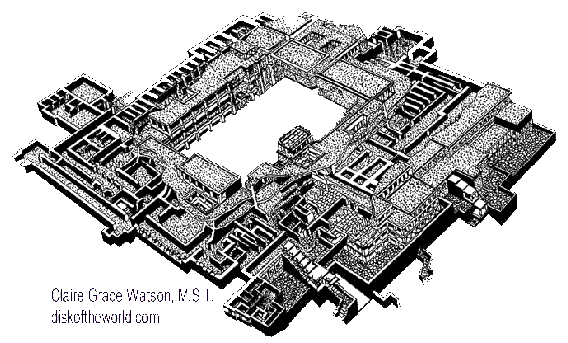
PALACE AT KNOSSOS, CRETE
Amazement
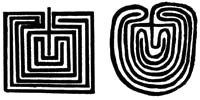
Two such Hopi Indian mazes, round and square, (above) are said to symbolize the human body and the axis of the world. This instructs about the relationship of microcosm to macrocosm. As a point of interest, the axis of the universe, according to ancient beliefs, is the Pleiades in Taurus. The implication is that our bodies are somehow intimately connected to a point far away in space, in the Taurus constellation. As this book will attempt to show, both mazes symbolize the vortex-portal, a geophysical and metaphysical phenomenon that exists as part of our reality and that gives us access to that distant point in space, to a place in Taurus, for example, to which we are apparently intimately tied.
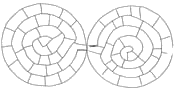
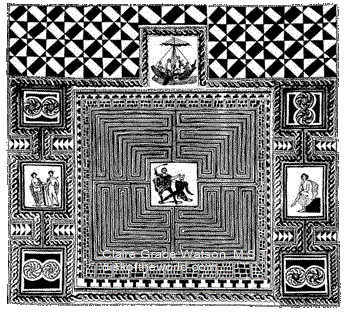
Now about these mazes, the Maze of Daedalus marble and limestone tile mosaic, 15 ft. wide and 18 ft. long, was discovered in 1815 on the floor of a barn in Austria. It probably was completed in the 4th c. CE, long before Arabic numerals were used extensively in place of Roman numerals. This is mentioned because there are six number 4's camouflaged in the mosaic. As for the history of maze mosaics, the leading artists of the Greco-Roman world developed mosaics in ancient Greece. The art form evolved in ancient Crete where the people gathered pebbles from the beach and set them in a cement bed to provided durable flooring in homes. The Maze of Daedalus mosaic demonstrates the artistic device of "continuous representation," which is the depiction of successive incidents or scenes within a single composition. Continuous representation is a narrative device first used in ancient Mesopotamia by artists telling a story with their art. This maze mosaic artist uses continuous representation to tell a story that portrays the 4th dimension of time, a dimension in which an objective "now" does not exist. This is an interesting way to portray the 4th dimension, by using a two-dimensional image, and it shows a great intellect at work in the creation of this masterpiece, Maze of Daedalus. It also proves the Maze of Daedalus legend was known in the 4th century, even though the Cretan civilization itself was not known to exist outside of legend until excavated by Sir Arthur Evans in the early 20th century. We will look closer at this square maze, but first the round maze of the Phaistos Disk.
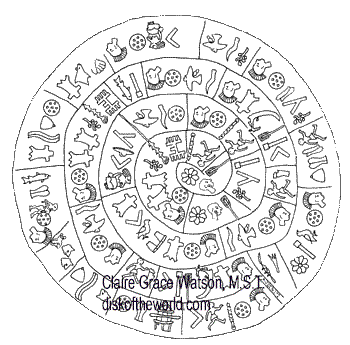
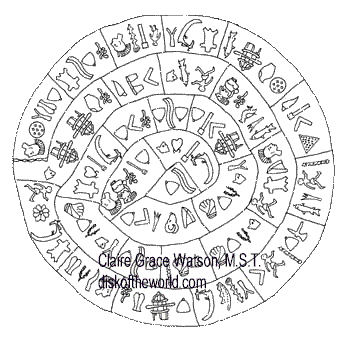
The Phaistos Disk (below bottom) is a terra-cotta disk ceremically fired and hardened for preservation unlike the thousands of artifacts that were baked. The disk is a perfect picture of the universal and astrophysical vortex-portal with the elements of creation stirring round and round. It is only 6-1/4" in diameter and 1" thick. It was found in 1908 at Phaistos, Crete, beside a tablet of Linear A writing of ancient Crete.
The Phaistos Disk is esteemed by archaeologists as something special and is 2 spirals inscribed with unique signs or pictographs in a unique style of continuous representation.
The signs were impressed with 47 different stamps, 37 of which were repeated. This is the earliest printing press technology known in the Western world. (This was the accepted explanation when I wrote this book, and it still is. However, I have proven this theory to be incorrect. See my recent discovery of how these pictographs were impressed onto the disk here.)
On Side 1 of the disk (above top), 121 impressions were made with 35 different stamps and on Side 2 (above), 119 impressions were made, again with 35 different stamps. Archaeologists believe the pictographs represent a language. It is a symbol language.
|

QUEEN'S BATHROOM, PALACE AT KNOSSOS
The Minoan Civilization
The origin of the disk and the setting for the maze mosaic is Bronze Age Crete during the fabulous Minoan civilization that some scholars say gave rise to the legend of Atlantis. This particular Atlantis theory meets with resistance from ET enthusiasts, who insist that an advanced civilization really did once exist on this planet. Was that civilization Bronze Age Crete?
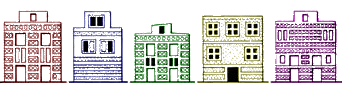
From our perspective the Minoan civilization seems unbelievably advanced for its time (1600 BCE). The people lived comfortably in adobe townhouses that had rooftop patios (above). They enjoyed plumbing and bathtubs and flushing toilets. The Cretans invented paved roads and paved them with shell and rock. The gay frescos in the palaces portray the people as wealthy, carefree, sophisticated and uninhibited. Their luxuriant lifestyle was a sudden advance from the primitive one immediately preceding it, and archaeologists cannot find an explanation for the overnight change in this civilization from mud huts and nearly nonexistent Bronze Age technology to architecturally designed palaces, complete with 20th century conveniences.
Some of these things can be explained by the fact that the Cretans, unlike the Sumerians and the Egyptians, spent their wealth on themselves rather than on temples and religious monuments. No doubt they gave great consideration to their own comfort and entertainment--hence the palaces and the extravagant spectacle involved in the bull sports. But archaeologists and historians, lacking religious artifacts from this period, underestimate the intelligence of this civilization by speculating that the Cretans were an earth goddess society. The religion of the Cretans was aniconic because, as the Phaistos Disk will show when we study it closely, the Cretans themselves were the embodiment of their spiritual beliefs in their manner of dress, in their lifestyle and in their artistic expression. Each Cretan lady was an Isis Unveiled; each gentleman was an Osiris. But first, let us take a close-up look at the Minoan civilization.

The isle of Crete during the Bronze Age had many active ports, a powerful and unchallenged navy, beautiful palaces, superb architects, excellent hydraulic engineers, and people who loved bull sports. But this modern prosperity was no defense against the volcano, the earthquakes and the tidal wave that destroyed the civilization in just one day and night.
Atlantis also has been described using the same words. It was supposed to have had a powerful and magnificent island state with many ports, an unchallenged naval fleet, beautiful palaces, superb architects, excellent hydraulic engineers, and people who loved bull sports. Alas, Atlantis was destroyed in one day and night by the volcano, the earthquakes and the floods. So it was that the beautiful people--the Cretans-Atlanteans--vanished.
The destruction of Crete erased nearly all evidence of its flourishing civilization that was not known to exist outside myth and legend until the 20th century when its discovery shocked the world. Even so, a tile artist in the 4th c. CE, who could have known nothing of the palace at Knossos, provided specific details of its ground plan in the Maze of Daedalus mosaic. To gain the revelation of interstellar flight portals and to see how they are connected with this maze mosaic, we must dive into the story of the Minotaur, a monster apparently, a horned being who ate humans. When we do, we will discover that the maze mosaic works on multiple levels, all of them interconnected. At another level, and camouflaged on the maze mosaic, is the incredible depiction of the remarkable events that occurred in Egypt at the Great Pyramid of Cheops sometime before 1600 BCE. That revelation is another "thread of Ariadne," which we will follow later on. But first, a close look at the Maze of Daedalus mosaic.
The maze mosaic can be said to be a record of lost Earth history--a history that begins to be revealed as the mosaic tells of the legend of the Maze of Daedalus and its three stars: Theseus, Ariadne, and the Minotaur. But notice if you will that in the background of the maze, and straining to emerge, is the possible portrayal of the moment the Sirians arrived at Cheops from the star Sirius in Canis Major. Then, as the maze puzzle is resolved, the mystery of its connection to Cheops becomes the new puzzle, resolved in turn by the Phaistos Disk. But, first things first.
|
|
SHROUDED IN MYSTERY (DRAG ME!)
Out in the Deep Dark Sea
Portrayed in the tile mosaic is the famous Maze of Daedalus legend of ancient Crete, passed down through time in the guise of a remarkable story, as told to us by the mysterious Greek poet, Homer.
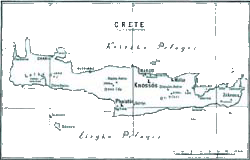
Out in the deep dark sea there lies a land called Crete, a rich and lovely land, washed by the sea on every side and boasting ninety cities. One of these cities is called Knossos, and there King Minos ruled and enjoyed the friendship of almighty Zeus.
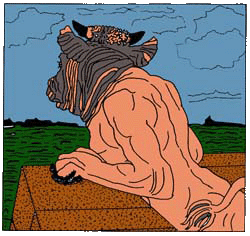
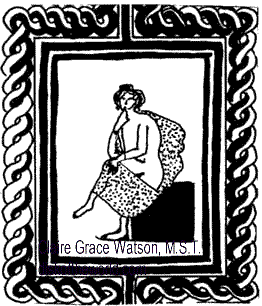
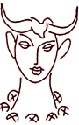
Poseidon, god of the sea and special god of Plato's Atlantis, presented King Minos with a white bull. Queen Pasiphae (above, Illus. 1), the king's wife, lusted after the bull! Pasiphae asked Daedalus, the palace architect, to design a bed for the mating to take place! Daedalus complied and the result of the mating was the Minotaur, half-bull, half-human. (left, Illus. 2)
The Minotaur was housed beneath the labyrinthine palace at Knossos. The palace contained so many twisting passages, staircases and subterranean rooms that it is believed to be the legendary Maze of Daedalus. (Illus. 3)
|
CENTRAL COURT
Central Court
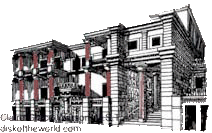
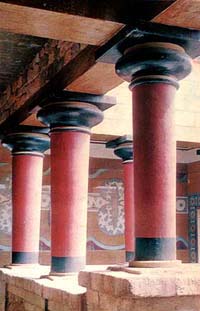
The palace was designed around the continuous activities of the Central Court, with the western facade as the focus (above). Central Court displays the Cretan designed upside-down Doric columns (above and left) and two of the famous Figure 8 shields of ancient Crete (left).
The palace was as big as Buckingham Palace, containing 800 rooms and covering 6-1/2 acres. At the beautiful palace, with the city of Knossos in the background, was an entrance via a stone viaduct at the SW corner of the palace.
|
The Minotaur
|
Beneath the palace where the Minotaur lived in the depths of the labyrinth, excavators discovered water channels and conduits for heavy rainfall and huge drains large enough to stand in and walk upright. The palace was supplied with running water and flushing toilets, the result of the work of the brilliant hydraulic engineers who built this elaborate plumbing system, unique in the Bronze Age. The Minotaur roamed this subterranean, labyrinthine plumbing and drainage system beneath the palace.
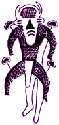
The Minotaur was fed young Greeks, war tribute paid to King Minos by the king of Greece. The Greeks were put in the maze, where they wandered hopelessly lost until the Minotaur found them and ate them. This part of the legend, the eating of humans, is dramatically illustrated by the rock drawing (above) found in a cave in Auanrhet, Tassili in Africa, in which this Minotaur takes a bite out of the leg of a frightened young woman. This Minotaur is equipped with some kind of body pods or antennae. This legend of a horned being who eats humans is resurfacing again in the 90's, in modern ET lore. Perhaps there is some truth in it. Here is another cave drawing (right) that seems to indicate its possibilities.
|
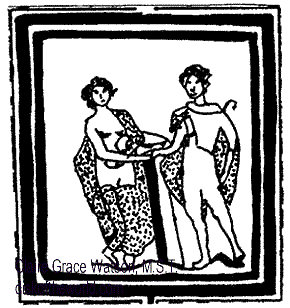
One of the Greeks the Minotaur was set to eat was Theseus, the son of the king of Greece, who sailed to Crete as a member of a sacrificial group but who planned to eliminate the Minotaur. Theseus, both then and now the greatest hero of Greece, enlisted the help of Ariadne, King Minos' daughter and the Minotaur's stepsister, to lead him into the maze. She in turn consulted Daedalus, that mysterious Cretan-Atlantean so active behind these scenes.
Daedalus advised Ariadne to take a ball of thread, now known as Ariadne's Thread of Love, to unwind inside the maze for Theseus to follow back out. Ariadne and Theseus are seen preparing to enter the maze from the top square of the Maze of Daedalus mosaic (top of maze), that is an exact drawing of the 4th c. CE tile mosaic.
At this point we must move to the next dimension of meaning in order to understand the significance of the maze and to arrive at its solution. The great and mysterious alchemist Fulcanelli will now take us to that level. "The picture of the labyrinth is thus offered to us as emblematic of the whole labour of the Great Work, with its two major difficulties, one the path which must be taken in order to reach the center-where the bitter combat of the two natures takes place-the other the way the artist must follow in order to emerge. It is there that the thread of Ariadne becomes necessary for him, if he is not to wander among the winding paths of the task, unable to extricate himself." (1)
When an alchemist refers to the Great Work, the reference pertains to something profound and includes the concept of space-time and energy-matter as being a curtain hanging between us and the nonspatial world. The Great Work has to do with lifting the curtain or with gaining access to the nonspatial realm of existence. One of the concepts involved here has to do with where the curtain lifts, and it also involves the esoteric spiritual legacy left us by the Sirians.
When the curtain lifts, it goes up in both subjective-nonordinary reality--so that knowledge is acquired in a mystical way--and it goes up in objective-ordinary reality, so that distance in objective, interstellar space is negated. The relationship of one to the other is All. When the curtain lifts, a portal is created and a privileged position vis-a-vis the universe is attained. From this position can be assessed the unseen, unknown realities. Some of these realities are unperceived by us because, says the alchemist Walter Lang, "Only a minute cross section of the total cosmic spectrum is bent by the senses and so rendered tangible." (2)
The entrance into the inner cosmos of subjective-nonordinary reality and into other planes of existence that we do not ordinarily perceive is via a spiraling path or Shamanic tunnel. Have you seen it? Its geophysical counterpart is the vortex. The meaning of the maze, whether square like the maze mosaic or round like the Phaistos Disk maze, is 'vortex-portal'. The alchemists also called the Maze of Daedalus "Absolum." Walter Lang reminds us: "We would point out that this term (Absolum) is close to the Absolute, which is the name by which the ancient alchemists designated the philosophers' stone." (3) So we begin to see we find something profound in the Maze of Daedalus and the Phaistos Disk.
|
|
THESEUS AND ARIADNE
Theseus and Ariadne
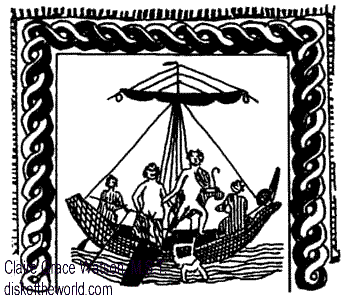
Even so, the maze mosaic seems to have been designed as a puzzle to be solved. The Maze of Daedalus tile mosaic is a graphic maze puzzle, defined as "the solution of which is an uninterrupted path through an intricate pattern of line segments from a starting point to a goal." This fits our maze puzzle perfectly. Close examination of this maze mosaic reveals a maze puzzle with no obvious uninterrupted paths from a starting point to a goal. Here we go. On the mosaic, Theseus and Ariadne are seen disembarking from a boat in the top square. (above)
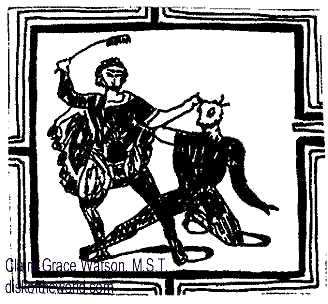
Then, Theseus is in the center of the maze where he is battling the Minotaur. (above top) As the battle ensues, Ariadne waits in no distress on the right. (above) Finally, Theseus and Ariadne are seen on the left turning a wheel. (below)
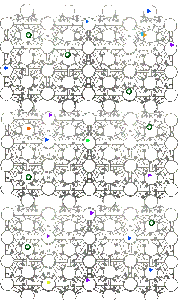
For comparative purposes and for mapping, we use the World Soul glyph (next, Illus. 4, see Forms and Archetypes of the World Soul.) This glyph is a complex and completed version of the Kabala Tree of Life.
|
SPACE-TIME CONTINUUM
Space-Time Continuum
The starting point is the top square where Theseus and Ariadne are leaving the boat to enter the Maze of Daedalus. The goal is the Minotaur's square at the center of the maze and Portal 4, P4, on the glyph (representing, as discussed in Forms and Archetypes of the World Soul, the curtain of space-time and energy-matter). Several World Soul glyphs joined together represent a continuum. Drag these Kabala Trees together and join them at the spheres to make the continuum. Overlap several spheres to see the natual holographic effect. (Images are dragable.)
Looking back at square one, where the lovers Theseus and Ariadne are entering the maze, notice they are entering behind a curious creature, a white dwarf that is diving in ahead of them. He is significant. The legs of the dwarf are in the shape of a 4, the first of six 4's in this puzzle, indicating their destination is P4. The dwarf is positioned upside-down like The Hanged Man of tarot.
 Following Ariadne's tarot thread now, we find that the Hebrew letter attribute of The Hanged Man is Mem, meaning water, and the numerological attribute is 40 or 4. The Hanged Man symbolizes the dive into the unconscious mind on an inner journey to the interior of the self, to arrive at the understanding of the nature of consciousness--and for the moment we will accept this as the purpose of our journey.
The tarot deck is key to the resolution of the maze, perhaps offering proof of the existence and use of tarot 1100 years before the oldest surviving 15th c. CE deck. Familiarity with the Rider-Waite tarot deck is helpful to the solution of the maze because the artist of the maze seems to reference tarot and because the Rider-Waite deck was designed by members of the Hermetic Order of the Golden Dawn, an order that is the apparent repository of ancient Egyptian Hermeticism. Tarot cards are supposed to have originated in ancient Egypt with the Osiris sect. Both the maze mosaic and the Phaistos Disk will help validate this belief.
The maze mosaic appears to be a surface, or that which has length and breadth only. This is illusory, as it has depth as well. A comparison of the mosaic with the glyph representing the curtain of space-time and energy-matter (your creation above) reveals this third dimension. The narrative device of continuous representation, in which an objective "now" does not exist, provides the 4th dimension of time.
 |
The dive into the maze is the entry, as indicated by three clues provided by the artist(s) who created this incredible puzzle. The dive is along the uninterrupted, straight-down-the-middle path of Vertical 1 (V1), which is just beneath P1 (see the Kabala Tree above for the numbered spheres and paths referenced here). Theseus, who is subduing the Minotaur with a scourge, provides the first clue to this entry into the maze. Theseus also carries a crook. Look back at the boat square. He is shown in the boat square with a crook. Look at the Minotaur square. He is flailing the Minotaur with a scourge. The crook and scourge are symbols of Osiris, the god-king named for the star Sirius. Osiris holds the crook and scourge (above right), the ancient Egyptian symbols of the Three Primordial Principles (good or light, evil or dark and intermediate or transcendent), which is part of a geometry-based number philosophy wide-spread during the time discussed here (Maze of Daedalus mosaic, 3000 BCE and 4th c. CE). This number philosophy is covered later on.
The Three Primordial Principles, as expressed by the philosophy of the ancient world, represents civilization's first perceptions of electromagnetism and positive-negative polarity. The Three Primordial Principles are said to be the cause of the creation of the universe, which came into being as a result of the interplay between the two opposing principles (Yin-Yang in Chinese mysticism) and the Intermediate principle of unity or negation (the neutron in physics). The Three Primordial Principles at work in the creation of the universe is demonstrated by the three pillars of the curtain of space-time and energy-matter (left) at work in the formation of the vortex and physical world. The vortex-portals in the curtain of space-time and energy-matter--physicality in other words--keep us separate but hold us together at the same time.
The crook and scourge of Hermeticism are analogous to the right and left pillars of the curtain (and also the right and left pillars of Solomon's Temple). The crook and scourge surround the central pillar of the curtain and represent the balance between Mercy (the crook and positive right pillar) and Severity (the scourge and negative left pillar). By these correspondences then, the entrance into the maze is along V1, the central pillar. Diving deeper now, to gain more meaning still...Osiris with crook and scourge is seen on the altar of the Hermetic Order of the Golden Dawn (above right), symbolizing Sirius in the center of the heavens amid the seven planets. This particular design represents part of the revealment of the Phaistos Disk.
 |
The second clue to the entrance into the maze is provided by the large Tau crosses (alchemical meaning--As Above, So Below) at the bottom of the maze mosaic. Just above the large Tau crosses are big squares, and above the big Tau cross, far right, is a big square showing in miniature the top of the maze as it would appear if P1 (top sphere on the World Soul glyph) were not intersecting H1. When P1 is lowered to H1, P4 is lowered out of position exactly between P5 and P6 (second spheres down on the right and left), where we see it on the maze mosaic. This miniature of the maze is a reversed number 4 meaning, in mysticism, "open channel." This refers to the open channel of V1 and to the open channel of the portal in the curtain of space-time and energy-matter.
The Tau crosses provide the third clue. When the right arm of the horizontal bar of the Tau cross is removed, an upside-down reversed "L" appears, the Hebrew letter Daleth meaning The Door. The numerological equivalent of this letter, Daleth, is the number 4. The Door (portal, Porta Lucis, light door, stargate) is the intersection of P1-H1 (P1 is the top sphere and H1 is the first horizontal bar down from it). Two tiny squares break the Tau cross pattern just beneath the boat square and mark the parameters of The Door.
This is the domain of The Empress of tarot, Hebrew letter attribute Daleth. In mysticism she is the curtain guarding the portal; she is the entrance to the physical world. Her portal is a two-way door to the central pillar (V1) of space-time and energy-matter. She rules the Limit between the physical world and the Mundus Archetypus.
 |
Turning now to the palace at Knossos (left), and diving still deeper for meaning, Theseus and Ariadne entered the maze at P1. This is the front door of the palace at Knossos, marked by "A," where is located a geophysical portal corresponding to the inner world portal. This corresponds to the entrance point of Light-Power at the top of the head (the soft spot), designated the fontanelle in modern shamanism and the crown chakra in Hinduism. We are showing a correlation of the journey of Theseus and Ariadne into the palace and the journey of the spirit through the fontanelle. (This is deep, isn't it? This material is multidimensional, so it can seem like slow going. But keep going -- it is well worth it!) Once inside the maze, the couple continued along V1, a long plumbing pipe beneath the hallway of the palace, to P4 beneath Central Court, where Theseus encountered the Minotaur.
When the battle of Theseus and the Minotaur ensued beneath the palace at Knossos, Ariadne walked upward from P4 through the maze, trailing the Thread of Love behind her for Theseus to follow. The path of the thread can now be identified as an uninterrupted path from a starting point--P4-to a goal-P5--where Ariadne waits.
 |
Upon reaching P5 she grounded the ball of thread, which is the circle and semicircle directly in front of her on the inside of the small Tau crosses. Because she is on a plane or a level of existence with P5, as shown on the curtain of space-time and energy-matter (see World Soul glyph), she entered the isolated square by simply stepping over the Tau crosses, the ellipse of the maze, the pipes and the drains of the palace, and into the square where she sat down on the stairs and waited.
 Diving deeper for the identity of Ariadne, she is the nude woman on The Star card of tarot, the star being Sirius. She is the seminude woman on The World card. In this respect she is Isis Unveiled and Isis-Sothis, the High Priestess of Thoth and of tarot. Sothis is the ancient Greek name for Sirius, which the Egyptians called Sopdu. The Unveiled Isis-Sothis symbolizes the lifted curtain. Both Isis of tarot and Ariadne wear only a cloth covering the abdomen; both are encircled by an ellipse; and both cross their legs in the shape of a number 4, meaning open channel. The Hebrew letter attribute of The World card is Tav (Tau), meaning cross, and the numerological attribute is 400, or 4. This references the open channel amid the Tau crosses.
The deeper meaning of Ariadne relates to the role of the High Priestess of tarot and of Ariadne-Isis-Sothis. They symbolize the memories carried in the unconscious mind, and we can see this symbology as a kind of clue as to how the maze mosaic was conceived. The High Priestesses bridge the abyss and access the Universal Mind wherein is contained the knowledge of what is, what has been and what shall be. The essence of the High Priestess is water, and her open channel is the stream of consciousness. She is Path 13 (V1), numerologically 4, the path that connects P1 (Source) to P4 (Truth). The Hebrew letter attribute of the High Priestess is Gimel, meaning camel--the water bearer. "And of the stars they consider Sirius to be Isis's--as being a water-bringer." (4)
The long line of High Priestesses forms a caravan of camels traveling across the ages, with the line of descent leading from Isis to Ariadne to the maze mosaic artist to this writer and to others.
At the Isis level of representation, the white dwarf diving from the boat is Diktys, the nursling of Isis who fell head-first out of the celestial boat or baris of Isis and into the Nile River and was drowned, in trying to catch onions with his hands.(5) The onion, layer upon layer, is the maze-vortex-portal, and Diktys is seen on the maze mosaic diving for the big onion--the Maze of Daedalus. Egyptian priests gave this part of the Osirian mythology a literal interpretation and refused to eat onions! (6)
As Theseus encounters the Minotaur, Isis-as-Ariadne is seated in the palace of Knossos on the bottom steps of the stairs to the Royal Apartments, the stairs beside "A" on the enlarged detail of the ground plan. (below left) The Royal Apartments are coded "B" on the illustration of the palace ground plan. (above) 3,600 years ago, Ariadne sat on these stairs (below) and waited for her new lover to finish the Minotaur or be finished by him.
Now ensues the "bitter combat of the two natures," represented by Theseus (human-heroic) and the Minotaur (human-beastly). Theseus vanquishes the Minotaur and follows Ariadne's Thread of Love upward through the maze to ground level, to converge with her in P5. Together, they walk through the portal seen at the back center of the image (above), and enter Central Court. They cross over Central Court to P6 via H2, the invisible parallel plane of existence horizontally layering the maze.
At P6 is a wheel cross atop a monolith, part of the hydraulic engineering system of the palace. They turn the wheel and release the water through the pipes and the drains and float the Minotaur along the Central Pillar out of the palace and into the river (of the stream of consciousness or the universal mind).
Theseus and Ariadne board the ship and sail away on the beautiful blue Aegean, leaving us plenty to think about. As the ship in P1 sails from the rocky shores of Crete, P1, P4 and P7 are lifted back into their proper positions, exactly center the portals of the outer pillars. Theseus and Ariadne sailed to the isle of Naxos, according to legend, but perhaps they first visited Egypt and Cheops. From a different perspective it can be seen that Theseus and the Minotaur, at the center of the maze-vortex, are also at the bottom, center, of the truncated Great Pyramid of Cheops. (Now do you see the hidden dimension of depth?) This intriguing development leads us to Egypt and Cheops by way of the Phaistos Disk of Bronze Age Crete. We turn now to the disk for clarification of these Cretan-Egyptian-Osirian mysteries. But to finish the story of Theseus and Ariadne. When they arrived at Naxos Theseus proved to be fickle and abandoned her there. Dionysus (the Greek equivalent of Osiris, husband of Isis) fell in love with her and crowned her a queen of heaven, which she well deserved for her efforts on behalf of her country and her lover!
|
ANCIENT AEGEAN WORLD
The Shields
On Side 1 of the disk (above top) are 6 arrows (left) resembling the 32 arrows on the maze mosaic. Tracing paper is placed over Side 1, a point is placed at the position of each arrow, and the points are then connected with lines. The Great Pyramid of Cheops emerges (below), with its 4 planes converging at the vertex.
The arrows represent Cheops. 
By this connect-the-dots method can be derived other recognizable and exciting patterns. On Side 1 of the disk are 15 round shields, each containing 7 dots. A man is holding one of the shields in his hand, defining them as hand shields. In this symbolic 4-way convergence, the name "Pacal," (Mayan king Lord Pacal) means "hand shield;" an anagram of the name of the mysterious alchemist Fulcanelli is "l'ecu finale," meaning "the final shield;" and by placing Sides 1 and 2 of the disk together, as indicated by the matching line segments on the outer shells of each side, the famous Figure 8 shield of ancient Crete is produced. (below right)
The 7 dots within the shields of the disk form a hexagon like the hexagons of the curtain of space-time and energy-matter which compares favorably with the Figure 8 shields. The dots inside the shields represent the 7 planets known at that time, including the sun and the moon and excluding Earth; they are Saturn, Jupiter, Mars, Mercury and Venus. A round shield identical to those of the Phaistos Disk is seen on the Riddle of the Stone, also known as the Vitriol Acrostic (below), which alchemists, after the 16th century, held in superstitious reverence.(1) (The Vitriol Acrostic may be the alchemical descendant of the ancient frescoes of the Atum-cult period in Egypt which show "the sun sending forth rays, each furnished with a hand for giving and blessing." (2) Alchemy began in Egypt, which was once called Chemmis. "They call Egypt Chemia," (3) or Chem-Egypt, hence Alchemy.)
On the Riddle of the Stone (left. Illus. 1) are various symbols for the 7 planets. Top left are 7 small circles representing the 7 planets; top center are 7 symbols, one for each planet; and at the bottom are various shields. Identical to the shields on the disk is the round shield, bottom left, within which are 7 dots of hexagonal arrangement representing the 7 planets. To the right of this shield is the 7-pointed Hermetic Star, each of the 7 points representing one of the 7 planets.
Each of the [Seven] Planetary Spheres is a complete World containing a number of divine offspring, which are invisible to us, and over all of these Spheres the Star (Sirius) we see is the ruler.(4)
The round shield to the right of the Hermetic Star contains the Ring Cosmos and Ring Chaos of Ring-Pass-Not (limits the spread of the fiery cosmos) and symbolizes the Limit of the Hebdomad, the material universe of the 7 lower spheres or planets. The Hebdomad is represented on the curtain of space-time and energy-matter by the lower 7 portals (spheres). The two outer shields of the Vitriol Acrostic contain alchemical symbols in the form of mythical beasts connected by chains. They symbolize the planets as being "living creatures having bodies fastened by vital chains," (5) which hold them to the "appointed task of their orbits."
The "divine offspring" of the planets (see the quote) are nonmaterial spheres or spiritual levels of planetary existence. Around the edge of the Riddle of the Stone, which has been associated with the Emerald Table of Hermes Trismegistus (covered later on), is a Shamanic message meaning "visit the inward parts of earth; by rectifying thou shalt find the hidden [Philosopher's] Stone." The creator of the Riddle was Basil Valentine, the mysterious 16th century alchemist believed to have been a Benedictine monk.
Alchemical enigmas such as the Riddle of the Stone are common and are meant to convey secret information to those initiated into the mysteries. A famous text enigma created by the mysterious alchemist The Cosmopolite involves the 7 planets and supplies a link in the chain connecting the Riddle of the Stone, the curtain of space-time and energy-matter, and the shields of the Phaistos Disk. The Cosmopolite's text makes little sense without the information from modern Hermeticism (6) enabling the diagram of the planetary positions onto the portals of the curtain of space-time and energy-matter. (below right) The Cosmopolite will now speak:
|
Look at the sky and the spheres of the planets. You will see that Saturn is the highest of all, succeeded by Jupiter and then by Mars, the Sun, Venus, Mercury and finally the Moon. Consider now that the virtues of the planets do not ascend, but descend. Experience itself teaches us that Mars can easily be converted into Venus, but not Venus into Mars--Venus being a lower sphere. Similarly Jupiter is easily transmuted into Mercury, because Jupiter is higher than Mercury. The former is the second below the firmament, the latter second above the earth. Saturn is the highest, the moon the lowest. The sun mixes with all of them, but is never improved by the inferior ones. Further you will note that there is a great correspondence between Saturn and the Moon, with the Sun midway between them. There is also a correspondence between Mercury and Jupiter and between Mars and Venus. In the midst of all is the Sun. (7)
Concealed on the Phaistos Disk is the singular image of the 7 planets surrounding the fixed star of Sirius. This image is revealed by the placing a point at each symbolic shield (below) and connecting all but one of the points with lines. By this method, a star inside a heptagram emerges. The outside edge of the Phaistos Disk is traced around the heptagram design because the points inside the shields are encircled. A shield is placed at each point to show the exact location of the shields on the disk. Revealed is the star Sirius with its companion star, Sirius B. Double every line and the point representing the companion becomes connected.
Concealed on the Phaistos Disk is the original Hermetic Star, the emblem of the ancient Egyptian Hermeticists.
In the Egyptian sense, it is SIRIUS the Dog-Star, the Star of Isis-Sothis. Around it are the Stars of the Seven Planets each with its seven-fold counterchanged operation. (8) This design has come down to us through time and is demonstrated on these images from modern Hermeticism. (below)
Top left, Keys in the Enochian Language by John Dee (16th c. CE) click on image for larger view; second from left, Osiris altar, Hermetic Order of the Golden Dawn, 20th c.; third from left, ceiling of the tomb of Christian Rosenkreuz, 18th c. CE, Roscicrucian; right, floor of the tomb of Christian Rosenkreuz, 18th c. CE, Roscicrucian; bottom left, Keys in the Enochian language, geometry design, bottom right, Hermetic Star of the Phaistos Disk.
By all these correspondences we can arrive at the decipherment of the hand shields of the Phaistos Disk. They represent the visible universe of the 7 planets. Therefore, the man holding the shield, the warrior and god-king Osiris, is a god--a being larger than the visible universe.
As the decipherment of the Phaistos Disk will show, the ancient Egyptian Osiris sect of the priests and priestesses of Thoth were engaged in their mystery religion deep inside Cheops, the "house" that may be marked by the "E" of the Phaistos Disk. "E" is the ancient Sumerian symbol for "House" and means house of the god (like church, synagogue, temple, etc.), and this common use of "E" demonstrates a cultural diffusion. The "Egyptian Book of the Dead" was known to the Egyptian priests as "The Book of the Master of the Secret House", this house meaning the great pyramid, otherwise called "Light." (9)
In subjective-nonordinary reality, the Master of the Secret House is Thoth--Divine Mind--and the Secret House in the inner cosmos is the counterpart to the sacred house in the physical, exterior world. In subjective-nonordinary reality, the curtain of physicality can be lifted and a portal created by the deliberate technique of meditating the Hermetic Star design of the Phaistos Disk as well as by working with the individual pictographs. They all have magical properties because they are based upon universal archetypes.
The ancient Egyptian religion was "one of the most grandiose religions of the Universe,"(10) "the deepest and most fascinating mystery of antiquity." (11) Thoth, the Master of Wisdom and Truth and the personification of the Mind of God (12) (Mind and Idea) (13) established the priests and priestesses of Isis and Osiris. It is Thoth who is the Master of the Secret House. In later accounts of him Thoth is Mercurius-Hermes Trismegistus, the legendary scholar who "taught mankind the arts of civilization after which 'he mounted to the stars.'" (14)
The entire mystery-myth of ancient Egypt, the events in the supernal and symbolic lives of Isis and Osiris, of Horus, Typhon, Nephthys and Anubis, are seen on the Phaistos Disk. This great Egyptian Religion of the Mind, the beginning of the Emanationist philosophical system in Egypt, was widespread and "virtually supreme at one time in popular Hellenistic circles." (15) It is only natural, then, and very fortunate, to find in Crete, 1600 years prior to the "popular Hellenistic circles" referenced above, and 1600 years after the religion's broad inception, a complete accounting of the mystery-myth of Isis and Osiris. On the disk we find a myth in transformation from Egyptian expression to Greek expression. Further, the disk and the myth may fingerprint alien participation in early Earth civilizations.
The mystery of the Osirians is recorded by Plutarch (46? CE - 120? CE), the Greek biographer and essayist, in his treatise "On Isis and Osiris." Plutarch, who was an initiate in the Isis-Osiris mystery religion (as is this writer), faithfully recorded the story but kept secret its meaning, offering little explanation for any part of it because initiates, historically, were sworn to secrecy. The Isis-Osiris religion centered on Sirius in Canis Major and featured the god-man Osiris-Sirius and his sister-wife the goddess Isis-Sothis (Isis-Sirius).
Now, to the myth itself...In the beginning Hermes (Thoth) and Rhea, the Father-Mother, were in love, and within Rhea's Womb life began to form. Inside Rhea's Womb--the Mighty Whirlpool and Vast Vortex of the infinite, symbolized perhaps by the spirals on both sides of the Phaistos Disk--all was "motion pure and simple, unordered or chaotic." (16)
Thoth (also Kronos or Time) introduced order into Rhea--creating space-time--and she gave birth to Osiris (Mind and Idea or Thoth's Image), and "a voice (Logos) fell out together with him on his being brought forth-to wit: 'The Lord of all comes forth to light'" (17) His birth was heralded: "Great King Good-doing Osiris is born." (18) After Osiris was born, out came his brother Aroueris, the Elder Horus, which was a prophetic birth foretelling the Horus (Cosmos or Energy) that was to come.
After Aroueris was born, the evil Typhon (Matter) leapt forth most unnaturally (because he preempted Isis or Nature) from the rib in Rhea's side. Isis (Nature or World Soul) was born next and then Nephthys. Before they were born, and because they were in love, Isis and Osiris (Soul and Mind) married, as did Typhon (Matter) and Nephthys (End) but they hated each other. Nephthys or End is the end of the emanations of Thoth and Rhea. In this Egyptian expression of Dualism or the Doctrine of Two Contraries, good Osiris and bad Typhon emanated from the same Source because "'reciprocal' is cosmos' harmony." (19)
There could not be apart good things and bad, but there's a blend of both so as to make things fair. (20)
Or, rather, seeing that Nature produces nothing, generally speaking, unmixed down here, it is not that from two jars a single mixer, like a tavern-keeper, pouring things out like drinks, mixes them up for us, but that from two opposite principles and two antagonistic powers--the one leading [things] to the right on the straight [road], the other upsetting and undoing [them]--both life has been made mixed, and cosmos (if not the whole, at any rate this [cosmos] which surrounds the earth and comes after the Moon) irregular and variable, and susceptible of changes of every kind. (21)
"Osiris is Sun and is called Sirius by Greeks." (22) "For they write the King and Lord, Osiris, with 'eye' and '
.'" (23) The sceptre of Osiris appears 4 times on Side 2; 5 times on Side 1.
Osiris orders the universe. This sign appears once on Side 1.
His name is derived from "sairein," meaning "sweep clean," in order to beautify and adorn." (24) The sweep of Osiris, which doubles as a scourge (see Theseus at the center of the maze mosaic) appears 4 times on Side 1.
And they say that when Osiris was king, he straightway set free the Egyptians from a life from which they could find no way out and like unto that of wild beasts, both setting fruits before them, and laying down laws, and teaching them to honour the Gods. (25) This triangle fruit that Osiris set before the Egyptians appears 15 times on Side 2, 3 times on Side 1. (The triangle fruit is the fruit of the triangle or geometry, i.e. knowledge or gnosis, which sets one free. This symbol may also represent the honey cake of Osiris or even a honey jar. It may also be a symbol for star.)
Good King Osiris as Mind and Idea empowered to participate in the give and take of creation went forth over the whole earth, cleaning it,  not in the least requiring arms, but drawing the multitude to himself by charming them with persuasion and reason, with song and every art he Muses give... (26) Osiris as heaven-walker going over the whole earth appears 5 times on Side 2; 6 times on Side 1.
Osiris "went forth over the whole earth, sailing the Heaven-Ocean in the Argo. (below) At the prow of the Argo is the pilot, the star 'Kanobus' (Canopus), or 'Pilot'--from whom, they say, the star got its name." (27) Osiris is the General and Kanobus is the Pilot. (28) The Argo is drawn by connecting together the tips of the triangle fruit (or stars) distributed by Osiris. If the symbol represents star, then the meaning seems to be that Osiris is credited with distributing the stars in the heavens.
And [they say] that the ship which Greeks call Argo is an image of the bark of Osiris, constellated in his honour, and that it sails not far from Orion and Dog, the former of which Egyptians consider the sacred [boat] of Horus and the latter of Isis. (Plutarch)
The Good-doing Osiris was away ordering the universe for: "...neither does the universe mindless and reason-less and guidance-less float in "That which acts of its own will,' nor is there one Reason [only] that rules and guides, as though with rudder as it were and bits obedient to the reins; but that [the universe] is many things and these a blend of evil things and good. (29)
While Osiris was away, evil Typhon determined to do away with him, but Isis held the power in his absence and prevented it. Like Tiamat of Mesopotamia, Typhon has a serpent's body and like Leviathan after him Typhon is the Great Serpent of evil. Also like Leviathan Typhon is indispensable to the order of the world, so long as he keeps to his place. When the opposites, thesis and antithesis, were synthesized in the Womb of Rhea, Typhon kept to his place, but when the harmony was disturbed Typhon rose up like Leviathan and like Teli the Dragon, who usurped Paradise and cast out Adam and Eve. Typhon usurped the throne of Good-doing Osiris and cast him out. Typhon, Tiamat and Teli may have been patterned on Draco, the constellation of the Dragon.
The Egyptians tell a myth about Zeus (Typhon) that, as in consequence of his having his legs grown together, he could not walk, for shame he lived in solitude; and so Isis, by cutting in two and separating these limbs of his body, made his going even-footed. (30)
When Good-doing, good-looking Osiris returned from ordering the universe, he mistook his sister Nephthys for Isis and slept with her. As a result, Nephthys brought forth Anubis, the jackal-headed embalmer god of the Egyptians.
Isis learned of Osiris' mistake when she saw the wreath of honey-clover that fell from him and was left behind in the bed. Isis went in search of Anubis, the child of this union.
Typhon would never have known of the union of Osiris and Nephthys had not Osiris left behind the wreath of honey-clover. The plant appears 4 times on Side 2 of the disk; 3 times with a dog that probably represents Anubis.
And when the Nile exceeds its boundaries and overflows more than usual, and [so] consorts with the extreme districts, they call it the union of Osiris with Nephthys--proof of which is given by the springing up of plants, especially the honey-clover, for it was by its falling [from Osiris] and being left behind that Typhon was made aware of the wrong done to his bed. Hence it is that Isis conceived Horus in lawful wedlock, but Nephthys Anubis clandestinely. (31)
There is, then, for the worshippers of Anubis some [mystery] or other that may not be spoken of. (32)
When Nephthys gave birth to Anubis, she exposed him out of fear of Typhon but Isis was guided by dogs to the baby and saved it.
Typhon, plotting to kill Osiris, built a coffin-chest in which to entrap him. A chest, in Pythagorean terms, is an odd-ly ordered rectangular encasement. (33)
But that after measuring out for himself in secret the body of Osiris, and having devised, according to the size, a beautiful and extraordinarily ornamented chest, brought it into the banqueting hall. (34)
All in the banqueting hall were delighted with the coffin-chest. Typhon offered to give the coffin to anyone whom it fit perfectly. At this time Osiris had been king for 28 years. (35) (There is a correspondence here to tarot cards, which were said to originate with old the Osiris sect. Path 28, D21 on the curtain of space-time and energy-matter, is correlated to The Star card in tarot. This path is the portal to the inner cosmos--the inner way. The journey Osiris takes while inside the chest symbolizes this inner journey.)
When Osiris got inside the chest and laid down, Typhon quickly sealed it. Then he and his cronies threw Osiris in the coffin in the Nile. Nothing is so precious to Egyptians as the Nile. (36) Osiris now becomes involved in a journey of purification--and we will accept that as the purpose of our own journey for the moment.
The pictograph representing the open coffin of Osiris appears 3 times on Side 2; twice on Side 1. The Nile sign appears 4 times on Side 2, twice on Side 1. After Typhon trapped Osiris in the chest and threw him into the Nile, the Pans and Satyrs living in Panopolis told the population the dire fate of Osiris, whereupon a "panic," derived from the name Panopolis, broke out. (37) Upon hearing of Typhon's terrible deed, Isis, all distraught, cut off one of her curls, put on a mourning dress and wandered everywhere asking all whom she met if they had seen the chest containing Osiris, but no one could help her, even though she was the queen and held the queen's sceptre.
 In modern Hermeticism of the 20th century, from The Hermetic Order of the Golden Dawn, Isis is seen holding a similar sceptre (left, Illus. 2).
Anubis helped Isis, the woman who had saved him from an early death. He told her of Typhon's evil deed and showed her where the body of Osiris had been thrown into the Nile. The eleven dogs on the disk also represent Hermes-Thoth, the Watcher, who like the dog is always alert even while sleeping. (38) The dog represents Isis, her soul being called Dog by the Greeks. (39) The dogs represent Sothis, also called Dog, (40) meaning the star Sirius of the Great Dog (Canis Major).
In olden times, indeed, the dog enjoyed the highest honors in Egypt; but seeing that when Cambyses slew the Apis and cast it out, no [animal] approached or touched its carcass but only the dog, he [thus] lost the [distinction of] being first and most honoured of the rest of the animals. (41)
The dog is honored on the Phaistos Disk because the artifact was created about 1100 years before Cambyses conquered Egypt (525 BCE) and slew the sacred Osiris-bull.
When Isis, Lady of the Heart and Tongue, learned of the deed done to Osiris, it broke her heart. The tree sacred to Isis was the Persea, because its fruit resembles a heart and its leaf a tongue. (42) This fruit appears twice on Side 2 of the disk. In remembrance of the sorrow of Isis when she mourned the loss of Osiris, Egyptian priests shaved their heads and wore linen clothing.
Now, as far as the 'many are concerned, even this commonest and smallest [secret] is hid from them--namely, why the priests cut off their hair, and wear linen robes; for some do not at all care to know about these things, while others say that they abstain from [the use of] the sheep's wool, as they do from its flesh, because they hold it sacred, and that they shave their heads through being in mourning, and wear linen things on account of the colour which the flax in flower sends forth, resembling the aetherial radiance that surrounds the cosmos. (43)
Appearing on Side 1 of the disk are two priests, the figure 8 on their cheeks perhaps symbolizing the curl that Isis cut from her hair. Beside each priest on Side 1 is a flax flower. The flower at the center of Side 1 represents the aetherial radiance that surrounds the cosmos." Three flax flowers are seen on Side 1; one on Side 2. The sacred sheep, which appears once on Side 2, is the symbol of Hermes (Thoth), the good Shepherd of Men. The ram with curved horns was widely recognized in Egypt to represent the god Amun.
Statues of Hermes Kriophoros, or Hermes with a ram or lamb standing beside him, or in his arms, or on his shoulder, were one of the most favourite subjects for the chisel in Greece. We have specimens dating to the archaic period of Greek art. (44)
After Anubis showed Isis where Typhon and his friends had thrown Osiris and his coffin into the Nile, she set out in her papyrus skiff (baris) (45) to look for him. The papyrus skiff appears 5 times on Side 2, twice on Side 1.
The coffin of Osiris was "wave-tossed out to Sea" to Byblos, a city in the Papyrus Swamps of the Delta. (46) The coffin came to rest against a heather-bush, (47) that grew into a hearty and beautiful heather-tree because of the body of Osiris inside its trunk. The king of that country so admired the magnificent heather-tree that he cut it down and installed it in his palace as a pillar in the roof. (48) He left behind a tree-trunk with 5 branches. (49)
Seen 6 times on Side 2 of the disk and 5 times on Side 1 is the "chen-Osiris" or "Osiris-plant," the ivy consecrated to Osiris. (50) The plant has 5 branches because it also represents the five-branched heather-bush that grew around the coffin of Osiris. From the ancient Chaldaean mystery-tradition of the Fire, 'five-branched' would thus mean man, or rather purified man, and the saying referred to the pruning of this tree. (51) Osiris in the Nile is the archetype for purification by baptism in sacred water. To the ancient Egyptians who farmed the Nile Delta, Osiris literally was the Nile.
The number five also is sacred because it symbolizes the hypotenuse of the "perfect" 3-4-5 triangle, the right triangle of the Pythagorean Theorem, divinized here 1200 years or so before Pythagoras proved it.
For the 'three' is the first 'odd' and perfect; while the 'four' is square from side 'even' two; and the 'five' resembles partly its father and partly its mother, being composed of 'three' and 'two.' (52)
We must, accordingly, compare its (right triangle) perpendicular to male, its base to female, and its hypotenuse to the offspring of both; and [conjecture] Osiris as its source, Isis as receptacle, and Horus as result. (53)
And panta [all] is only a slight variant of pente [five]; and they (the Egyptians) call counting pempasasthai [reckoning by fives]. (54)
Isis arrived in Byblos and met the people there, who noticed right away that her breath, hair and skin smelled like ambrosia. (55) Isis planned to retrieve the damaged coffin and body of Osiris from inside the heather-tree in the palace, and she entered the palace when the queen of Byblos employed her as a nurse for her baby son Diktys.
And they say that instead of giving it the breast, Isis reared the little one by putting her finger into its mouth... (56)
This sign of Isis Unveiled, Isis pre-eminently meaning "Nurse" in Greek, a further intensification of "suckle," (57) shows Isis nursing Diktys by placing her finger in his mouth. In mourning for Osiris, she "beats her breast." Because Isis cut off a curl and put on her mourning dress, whence the city to this day bears the name Kopto," (58) meaning "I cut or beat the breast, as a sign of her mourning. (59) The Isis-Diktys sign appears twice on each side of the disk, in each instance exactly equidistant apart.
I am all that has been and is and shall be, and no mortal has ever re-vealed my robe. (60)
Isis, her true identity unveiled or revealed, cut open the trunk of the heather-tree, exposing the damaged coffin containing Osiris. She placed it in her skiff and sailed away on the River Phaedrus. The damaged coffin sign appears twice on Side 1, once beside the open coffin.
The Egyptians celebrated the Burials of Osiris by cutting a tree-trunk and making it into a crescent-shaped coffin like the one containing the coffin and body of Osiris in the skiff of Isis. (61)
On Side 2 of the disk is the crescent-shaped coffin (damaged area) beside the skiff. The dots inside the crescent sign probably once numbered 28, the number of years Osiris reigned and the number of the lunar cycle.
The skiff of Isis is said to symbolize, in one respect, the body--the vehicle of the soul--which evil, symbolized by Typhon, pursues. In support of this, the skiff sign is found once in combination with the Typhon sign.
Isis, with Diktys traveling with her, sailed back to Egypt. It was on this journey home that Diktys fell headfirst overboard when reaching for the onions, as portrayed on the maze mosaic.
When Isis arrived in Egypt, she hid the coffin containing Osiris in the marsh swamps of Buto. (62) Because there was a full moon, Typhon was out hunting pigs with his hunting dogs. Typhon saw the body of Osiris and hacked it into 14 pieces (63) with his hatchet. Because of this, to eat the pig was taboo. (64) The pig and the dogs are on Side 1, and Typhon's hatchet is on Side 2.
Typhon cut up the body of Osiris into 14 pieces and scattered them abroad. The pieces of Osiris appear 15 times on the disk, the additional piece perhaps representing an additional symbolism. This symbol may also be imiut, the ancient Egyptian term given to the fetish consisting of a headless animal skin hung on a pole that was stuck into a pot, for protection. The pieces may be the early, and probably first, representation of the Archons, the planetary rulers whose flayed and stretched out skins form the sky in much the same way the body of the Egyptian goddess Nut formed the sky. Egypt had a mystical astrology which included fantastic figures scattered across the skies, and this is portrayed by the disk, whereon the numerous signs are scattered across the skies of both the Northern (Side 2) and Southern (Side 1) Hemispheres.
Once again, Isis set out in her skiff, this time through the marsh swamps of the Delta, to collect the 14 pieces of Osiris that Typhon had scattered.
And Isis [they say] on learning this, searched for them in a papyrus skiff sailing away through the marshes; whence those who sail in papyrus hulls are not injured by the crocodiles, either because they fear or rather revere the Goddess. (65) Three signs of the marsh appear on Side 2; one appears on Side 1.
As Isis found the pieces of Osiris, she put them in the skiff. Seen twice on Side 2 and twice on Side 1 is a piece of Osiris beside the skiff. After Isis collected the 14 pieces, she distributed images of Osiris, as though she were giving them the whole body, (66) to the cities of Egypt. With so many Burials of Osiris, never again would Typhon discover the body of Osiris and desecrate it. Egyptians celebrated the Burials of Osiris by cutting a tree-trunk and making it into the crescent-shaped coffin.
Horus, son of Osiris and Isis, was the avenger of his father, and his coming forth is his birth. The plumes upon his head are Isis and Nephthys when they go forth to set themselves there, even as his protectors, and they provide that which his head lacketh... (67)
The hieroglyph for Horus was the falcon on the perch, seen 3 times on the disk, once on Side 2; twice on Side 1. Horus is represented also by the golden hawk, who flies nearest the sun, and gazes upon it with unwinking eye. (68) (From whence may have come the Cretan legend of Icarus, son of Daedalus, who put on wings and flew to the sun to gaze upon it. The sun melted his wings and he fell to earth. By these correspondences, if Icarus is Horus, then the mysterious Daedalus is Osiris.)
The hawk carries in its claw the "Bone of Horus," (69) the naturally occurring magnet called the lodestone and bone of the sea-hawk. (70) The golden hawk with the lodestone grasped in its claw appears 5 times on Side 1 in combination with the snake, an ancient symbol of electromagnetism.
Isis found all the pieces of Osiris that Typhon had scattered, except for his generative member. Unfortunately, it was eaten by the Nile crab and the "sharp-snout fish, . As a result the crab and the sharp-snout were venerated by the Egyptian priests and declared taboo to eat.
Now, the only one of the parts of Osiris which Isis did not find was that which causes awe; for that it was cast straightway into the River...and the sharp-snout ate it up--which [they say] among fishes are considered specially expiate... (71)
...for as they venerate the sharp-snout fish, they fear that the hook is not pure when 'sharp-snout' is caught by it... (72)
Their priests, upon the other hand, abstain from all; and [even] on the ninth of the first month (September), when every one of the rest of the Egyptians eats a broiled fish before his front door, the priests do not taste it, but burn their fishes to ashes before he doors [of the Temple]. (73)
The Nile crab appears once on Side 1, and the sharp-snout appears four times in Side 2; twice on Side 1.
The phallus of Osiris is represented by the tall stalk of the papyrus plant, which "is supposed to resemble in its nature the generative member. (74) Kronos (Thoth) entrusted Pamyle, the wet nurse of Osiris, to keep the mystic rites in his honor, similar to the Phallephoria" (75) (Phallus-bearing). (76)
And when they keep the feast of Pamylia, which is phallic, as has been said, they bring out and carry round an image having a phallus three times the size of it. (77)
The tall papyrus is seen 3 times on Side 2, twice with an Osirian "heaven-walker," and once with one of the 3 right-hand signs symbolizing North, of both the cosmos and of Egypt. (78) "To ancient people the hand was a symbol of creative power." (The God and Symbols of Ancient Egypt, Manfred Lurker, Thames and Hudson, 1974, p. 57)
And there is a sacred dirge made on Kronos (Nile)--and it laments 'him who is born in the left-hand and died in the right-hand parts.' For Egyptians think that the eastern [parts] of cosmos are 'face,' the northern 'right hand,' and the southern 'left hand.' The Nile, accordingly, since it flows from the southern [parts] and is consumed by the sea in the northern, is naturally said to have its birth in the left hand and its death in the right hand. (79)
The right hand symbolizes Upper Egypt, and the left hand Lower Egypt. (80) The papyrus also symbolizes 'southern climate' of the cosmos, (81) or The Southern Hemisphere. On Side 1, the papyrus appears 3 times, each time with a heaven-walker.
Isis constructed a very good facsimile of the phallus of Osiris after the original was eaten by the sharp-snout and the crab. From the facsimile she got Harpocrates, Horus the Younger. After his death, Osiris, coming to Horus out of the Invisible, worked through him and trained him for the fight (82) (with Typhon), which lasted for many days and Horus won." Before the fight began:
And it was said that as many were changing over to the side of Horus, Thueris, Typhon's concubine, came, too; and that a certain serpent pursuing after her was cut in pieces by those round Horus. And today on this account they cast down a small rope and cut it in pieces for all to see. (83)
On Side 2 of the disk the pieces of the serpent that pursued Thueris appear once, beside the plumed head of Horus. On Side 1 they appear 5 times, each time beside the golden hawk of Horus. The hawk fighting the snake  symbolized the battle of Horus and Typhon. Horus was often portrayed as having a hawk's head and a snake's body--a sacred serpent-bird. "At Hermes-city, however, as image of Typhon, they show us a hippopotamus on which stands a hawk fighting a snake... (84)
Another legend involving this serpent is that of Apophis, the serpent with the severed head. In this image from the tomb of Inkherka, "the great cat" is beheading the serpent in order to save the Persea tree it has wrapped itself around.  
Each morning and evening the serpent demon threatened the son-god and thus endangered world stability. The 'huge serpent' was the embodiment of the opponent of God and a symbol of the powers of darkness. Therefore Apophis was equated with Seth (Typhon), the enemy of the gods. Each morning, when the son emerged from the nether-world, and each evening at the beginning of its nightly voyage, the sun barqoe was attacked by the serpent. This caused the sky to be dyed red with the blood of the defeated and wounded Apophis. The serpent also tried to hinder the sun's journey with its coils, described as 'sandbanks'. Several extant ritual texts refer to the 'overthrowing of Apophis' and provided magical protection, of which it was written 'it really saves him (i.e. the protected person) from all evil.' (Lurker, p.29)
The snake also symbolizes a star because it does not age, and moves without limbs with ease and pliancy. (85) In this respect, the snake may symbolize the constellation Serpens Cauda In Egypt, feasts celebrating the immortality of Osiris begin with a procession of the priests headed by a water-vase, symbolizing the Water of Life. The water-vase is seen twice on Side 2.
And they call not only the Nile, but also without distinction all that is moist, 'Osiris efflux;' and the water-vase always heads the processions of the priests in honor of the God. (86)
At the festivals of Osiris in Greece, the celebrants carry thyrsuses, (87) symbolic wands, generally cane-like or knotted like a bamboo, and sometimes wreathed with ivy or vine leaves, with a pine-cone at the top. (88) Two thyrsuses are seen on Side 2; two more on Side 1, one of them quite long.
In Greece is celebrated the Mysteries of Dionysus (Osiris), (89) and the women invoke him by praying for the god with the bull's foot to come to them. The bull's foot appears twice on Side 2, both times upside-down and both times in combination with an Osirian heaven-walker, symbolizing Osiris as the Apis-bull. It also may symbolize the constellation Taurus. The upside-down bull's foot, the upside-down pig, the vertical Nile and the Starship are reminders that the artist(s) of the Phaistos Disk intended it to be comprehensible only to initiates into the mystery-myth, who would know it right away for what it was.
A symbol is meant to direct the initiate to something higher and to reveal it to him at the same time, but it must also conceal this from the ignorant. Knowledge of the meaning of images was not accessible to everyone. (Lurker, p.9)
The women of Greece gave Dionysus (Osiris) the epithet of "bull-born and call(ed) him up out of the water with the sound of trumpets... they hid in thyrsi. (90) The trumpets are the legendary deep-toned (bellower) pipe of Idaean Kuretes. (91)
The water-vases on Side 2 appear each time beside what may be the "Cosmic House of Horus," (92) which may represent the procession of the priests. The Cosmic House of Horus also may represent a structure in the constellation Bootes.
And [they say] that when Isis had gone a journey to her son Horus, who was being reared at Boutos... (93)
Boutos or Buto may also mean the constellation Bootes, the Ploughman, (94) symbolized by the yoke. In this Egyptian mystery-myth staged in the heavens, it is only natural for the supernal Isis (Sirius) to travel the celestial Nile to various constellations, as seen from Cheops. Alternately, Isis (Sirius) is called the "Cosmic House of Horus." At the level of subjective-nonordinary representation, this "house," indicated by the second "E" may symbolize the Egyptian World-Building, (95) the metaphysical template upon which their temples were said to be modeled. At the supernal level, the Cosmic House of Horus (cosmos) is Isis (World Soul or Nature).
The World-Building was called "Sophia Above" by the Gnostics, "Heavenly Jerusalem" by the Jewish Gnostics, and wacah chan xaman waxac na--World Tree House of the North--by the Maya. This World-Building-Cosmic House bears a resemblance to Mayan astronomy glyphs.
The 11 walkers representing Osiris walking around the world, also are priests with shaved heads. They are heaven-walkers," "knowers of things divine, and the heavens they walk are both the outer cosmos of objective-ordinary reality and the inner spheres of the Ogdoad in subjective-nonordinary reality. (96)
...in those days [of ancient Egypt] of initiate kings and rulers and sages who occupied themselves with the Sacred Science, when the clear Aether spake face to face with them without disguise, or holding back aught, in answer to their deep scrutiny of holy things...In those days so great was their love of the holy mysteries, so high their virtue, that they left the earth below them, and in their deathless souls became 'heaven-walkers' and knowers of things divine. (97)
At death, the heaven-walkers ascend the 8 spheres of the vortex-portal, represented concentrically on both sides of the disk, by traveling inward along the downward spiraling Shamanic tunnel, symbolized by the disk. Heaven-walkers re-enter the astral or causal level of being, the "quantum domain level of the highest levels of light," (98) described in those days of ancient Egypt as the soul soaring across the awful chasms of the unfathomable depths to far-off Sothis, the Land of Eternal Dawn, to the Ante-chamber of the Infinite Morning. (99)
The heaven-walkers hoped to attain the Ogdoad, the Heaven-Sphere of the layered architecture of the celestial realms. The Ogdoad lies above the Hebdomad of the lower 7 spheres (see the curtain of space-time and energy-matter) of the planets and visible universe.
In this dramatic statement of polarity, the Ogdoad, symbolized by the 8-petaled flax flower at the center of Side 1, is the 8th level of heaven and Thoth's celestial City of Eight, in which were 4 pairs of divinities, each male and female, positive and negative, and active and passive. (See the curtain.)
The Ogdoad also is called the 13th Aeon (P1 on the curtain of space-time and energy-matter), believed by the ancients to be the Pleiades. (100) The 13th Aeon (an Aeon is a supernal power in its eternal realm) corresponds to the fixed stars above the 7 heavens of the planets (101) called the Hebdomad, symbolized by the original Hermetic Star concealed on the Phaistos Disk. In Trismegistic literature, adepts would enter into immortality and come to understand the Ogdoad, the destination of souls after death when the material body is abandoned and the soul re-ascends the planetary spheres, finally attaining to the Ogdoad to become one of its Powers--one of its Aeons--and to merge with the dead god-man Osiris and with God. This is the goal to which Hermetic gnosis aspired.
The 14 plumed profiles of Horus are reminiscent of the 7 pole-lords of heaven who make the axis turn. (102) They are like the Primal Creatures turning their spheres with sound. (103) Each one of the 8 spheres of the disk contains at least one Horus, one pole-lord or cosmic Aeon turning the sphere.
Thoth's city within, also called New Jerusalem in Kabbalistic Gnosticism, had its counterpart in Egypt's Khemennu, City of the Eight Gods. Thoth's temple at Khemennu was Het Abtit, House of the Net. (104)
Mystically it (the Net) signified the Veil (curtain) of the Universe, studded with stars, the many coloured Veil of Nature, the famous Veil or Robe of Isis, that no 'mortal' or 'dead man' has raised, for that Veil was the spiritual nature of the man himself, and to raise it he had to transcend the limits of individuality, break the bonds of death, and so become consciously immortal." (105)
Thoth's Net, which we will see later on ancient Sumerian cylinder seals, is the curtain of space-time and energy-matter as it was mystically perceived and recorded by artists of the period. The priests and priestesses of Thoth, who convened deep within Cheops, were called Beings of Light because, as mortals, they unveiled Isis, they re-vealed her robe. While still in the body they lifted the curtain of space-time and energy-matter and gained enlightenment from The Boundless Light. During the initiations into the mystery religion, the initiates were hood-winked with the hood of a robe, and were given two robes, the Robe of Isis, symbolizing the veil of Isis, which they wore openly, and the Robe of Osiris, which they put away. (106) The two hood-winks of the two robes appear on Side 2.
Wherefore when they have once and once only received this [robe], they treasure it away and keep it from all eyes and hands; whereas they use those of Isis on many occasions." (107)
After the initiation the Divine Mysteries were slowly revealed to the Select, and the priests and priestesses worked to elevate the initiates, called Mortals, to the grade of Intelligences, or those who had received the Nous (Mind), known to them as Thoth. At the center of the mystery-myth was the Ritual of the Portal and the means by which the physical person received in Divine Marriage a Heavenly Partner. The Nous or Heavenly Partner brings the Gnosis and the direct knowledge of the inner way to Thoth's celestial City of 8, the 8th sphere (Ogdoad) and infinity, symbolized perhaps by the figure 8's on the cheeks of the priests, by the 8-petaled flax flower, by the figure 8 shape of the Bone of Horus and by the Figure 8 shield formed by placing together Sides 1 and 2 of the disk. When the 8th sphere was attained, the initiates were no longer Mortals but Intelligences who merged themselves with Thoth and with Osiris, with Mind and Idea, for Osiris:
Himself is far, far from the earth, unspotted and unstained, and pure of every essence that is susceptible of death and of decay. Nor can the souls of men here [on the earth], swathed as they are with bodies and enwrapped in passions, commune with God, except so far as they can reach some dim sort of a dream [of Him], with the perception of a mind trained in philosophy. But when [their souls] freed [from these bonds] pass to the Formless and Invisible and Passionless and Pure, this God becomes their guide and king, as though they hung on Him, and gazed insatiate upon His Beauty, and longed after it-[Beauty] that no man can declare or speak about. It is with this the ancient tale makes Isis e'er in love, and, by pursuit [of it], and consort [with it], makes [her] full-fill all things down here with all things fair and good, whatever things have part in genesis. (108)
Let us do as Isis did. Let us re-member Osiris.
Remember Sirius.
FOOTNOTES
Footnotes: 1. John Read, F.R.S., Through Alchemy to Chemistry; 2. Mead; 3. Ibid., p.215; 4. Proclus, Commentary on the Timaeus of Plato, in Mead, Vol.3, p.198; 5. Plato, Timaeus; 6. Israel Regardie, The Golden Dawn; 7. The Cosmopolite in Fulcanelli; 8. Regardie; 9. W. Marsham Adams in Mead; 10. Mead; 11. Adams, quoted by Mead; 12. Wallace Budge in Mead; 13. Mind and Idea, part of the Emanationist Philosophical System, is covered in Portals of the World Soul by this author; 14. R.G.K. Temple, The Sirius Mystery; 15. Mead, Vol.1, p.57; 16. Plutarch, "On Isis and Osiris," Mead, p.194; 17. Ibid.; 18. Ibid.; 19. Ibid., p.255; 20. Heracleitus, Ibid., p.225; 21. Plutarch, Ibid., p.225; 22. Ibid., p.231; 23. Ibid., p.192; 24. Ibid., p.211; 25. Ibid., p.195; 26. Ibid.; 27. Ibid.; 28. Ibid.; 29. Ibid., p.225; 30. Ibid., pp.238-239; 31. Ibid., p.219; 32. Ibid., p.224; 33. Mead FN, p.196; 34. Plutarch in Mead, Vol.1, p.196; 35. Ibid.; 36. Ibid., p.186; 37. Ibid., p.197; 38. Ibid., p.193; 39. Ibid.; 40. Ibid., p.238; 41. Ibid., p.224; 42. Ibid., p.243; 43. Ibid., p.185; 44. Mead, Vol.2,p.35; 45. Ibid.; 46. Plutarch in Mead, Vol.1, p.198; 47. Wallace Budge in Mead, p. 198; 48. Ibid., p.199; 49. Ibid., p.198; 50. Ibid., p.218; 51. Mead FN, p.185; 52. Plutarch in Mead, Vol.1, p.234; 53. Ibid.; 54. Ibid.; 55. Ibid., p.198; 56. Ibid., p.199; 57. Mead FN, p.199; 58. Plutarch in Mead, Vol.1, p.1197; 59. Mead FN, p.197; 60. Mead, p.190, found inscribed at the seat of Athena in Sais; 61. Plutarch in Mead, Vol.1, p.222; 62. Ibid.; 63. Ibid.; 64. Ibid.; 65. Ibid., p.201; 66. Ibid.; 67. Ibid., p.234; 68. Mead, Vol.1, p.53; 69. Plutarch in Mead, Vol.1, p.238; 70. Ibid., p.238; 71. Plutarch in Mead, Vol.1, p.201; 72. Ibid., p.188; 73. Ibid.; 74. Ibid., p.217; 75. Ibid., p.194; 76. Mead FN, p.194; 77. Plutarch in Mead, Vol.1, p.217; 78. Ibid., p.214; 79. Ibid.; 80. Ibid., p.297; 81. Ibid., p.217; 82. Ibid., p.201; 83. Ibid., p.202; 84. Ibid., p.229; 85. Ibid., p.248; 86. Ibid., p.217; 87. Ibid., p.216; 88. Mead FN, p.216; 89. Plutarch in Mead, Vol.1, p.216; 90. Ibid.; 91. Ibid., p.128; 92. Ibid., p.235; 93. Ibid.; 94. Mead FN, p.200; 95. Philo in Mead; 96. Jean Doresse, The Secret Books of the Egyptian Gnostics; 97. Mead, p.69; 98. R. and V. Baer, The Crystal Connection; 99. Adams in Mead; 100. Doresse; 101. Mead, Vol.1, p.41; 102. Greek Magic Papyri in Mead; 103. See the Shroud of Turin in Portals of the World Soul; 104. Mead, p.41; 105. Ibid.; 106. Plutarch in Mead, Vol.1, p.251; 107. Ibid.; 108. Ibid., p.252.
Illustrations: All Phaistos Disk drawings are by the author. 1. After Basil Valentine; 2. After Regardie
|
|
SYMBOLS OF ENLIGHTENMENT (Drag them!)
Numerical Reality
The priests and priestesses of Thoth, believing that ultimate reality is numerical, that number is the key to the universe, that triangles are the fundamental building blocks of the cosmos and that geometry is the Sacred Science, instructed their initiates in three divine areas of thought: Sacred Geometry, astronomy and philosophy. The numbers 60 and 5 were particularly sacred to their Religion of the Mind.
The 30 line segments of each side of the Phaistos Disk total the sacred number 60. (One of the segments on Side 1, rather than being a line segment, is a long thyrsuses, the tall symbolic wand made from cane or bamboo.) The number 60, in Hermetic literature of a much later period but said to have originated in ancient Egypt, represents the number of subordinate orders of the 3 divisions of the main cosmos, of which "there is an orderly harmonius movement of one to the other." (1) In the microcosm and corresponding to this macrocosmic arrangement are 4 main divisions of soul-stuff with 60 soul-spaces, called zones, firmaments or layers, comprising the 60 types of souls.
And in these sixty spaces dwell the souls, each one according to its nature, for though they are of one and the same substance, they're not of the same dignity. (2)
The 60 soul types are layered in the Vast Vortex, the Crater or Cup that is the curtain of space-time and energy-matter. When the World Soul glyph that represents this curtain or veil is viewed from above, it appears as concentric circles. Around the edges of the circular vortex, the souls, sinking down, "flutter round the vortex in a circle, not daring to go straight through it." (3) The Mighty Whirlpool, the Mixing Bowl of the Creator, the within-without of the Shamanic tunnel and the mystical Spiral of Creation are all symbolized by the Phaistos Disk. The vortex, a rotating movement of cosmic matter round a center or axis, accounts for the origin or phenomenon of the terrestrial and other systems. The 60 soul spaces and the vortex are visible on the Phaistos Disk, Sides 1 and 2, when the signs have been removed. This spiral may also represent of the spiral movement of the star Sirius through the constellations.
The idea of the Cup or Mixing Bowl or the curtain of space-time and energy-matter as concentric circles or as round maze, "did not owe its origin to any invention of Plato's (427-347? BCE), but that the greatest of philosophers, when he makes use of the symbol, does but employ a familiar image well known to his audience...the symbol or image was a commonplace of the Orphic tradition, and doubtless, therefore, familiar to every Pythagorean." (4)
The vortex is also vertex, meaning "to turn or rotate." The vertex is the zenith, the point in the heavens directly overhead, represented by the flax flower on Side 1 and the triangle fruit and the Nile signs on Side 2 of the disk. The Pythagoreans, who got their science from Egypt, understood the vertex to mean the point opposite to and farthest from the base of a triangle, pyramid, or any figure having a base. Geometry thus originated with the study of the vertex-vortex and involved, pre-eminently, the triangle and its uses in describing the properties of a circle and the geometry of the sphere for use in astronomy.
The properties of a circle are described efficiently by pi, 3.1416. The original Egyptian symbols for pi as seen on the Phaistos Disk might be the "Y" sign, repeated 3 times on Side 1. The short line of the symbol is the radius (r) of a circle and the long line is the diameter (d). The ratio of the circumference of a circle (c) to its diameter (d=2r) is a constant number called pi, which equals c divided by 2r+3.1416. 2r with a vertex is a triangle = 3. The 14 pieces of Osiris = 3.14 = pi.
The triangle is the ancient Three Primordial Principles as expressed in geometry. The triangle is "sacred" because it represents the "plain of truth," the "hearth of the universe" and thesis-antithesis-synthesis. Gnosis is beyond reach unless one's feet have crossed the "plain of truth," meaning the study of Sacred Geometry and the triangle, particularly the magic 3-4-5 triangle.
The sacred 60 is also significant because long before 1600 BCE the 60-system of counting was used by the Mesopotamians, who were avid astronomers as were the Egyptians. The application of the sexagesimal (60-system) system in astronomy was continued by Greek and Hindu astronomers until about 500 CE. Since most of the constellation names originated in Crete and Greece, it is safe to say that because of the symbols on the disk and the knowledge of the use of the 60-system by Greek astronomers much later, the 60-system was employed by the Cretans in their astronomical calculations. The three 60's--the 60 soul types of the vertex-vortex, the 60 of the 3-4-5 triangle (3x4=12x5=60), and the 60-system of counting in astronomy--are inseparable syncretisms, in terms of symbolisms found on the disk.
And they (crocodiles of the Nile) lay sixty [eggs] and hatch them out in as many days, and the longest-lived of them live as many years-which is the first of the measures for those who treat systematically of celestial [phenomena]. (5)
That is (re: the celestial phenomena), presumably, either the 60 of the Chaldaeans, or the 3x4x5 of the 'most perfect' triangle of the Mathematici. (6)
The most perfect triangle, the right triangle, has its perpendicular [side] of 'three', its base of 'four,' and its hypotenuse of 'five...' (7)
And one might conjecture the Egyptians [also revered] the fairest of triangles, likening the nature of the universe especially to this... (8)
The Egyptians, millennia before Pythagoras, employed the magic 3-4-5 triangle of the Pythagorean Theorem, c2=a2+b2. The result, 25, was the number of letters in the Egyptian alphabet. (9)
And five makes a square equal to the number of letters among Egyptians, and a period of as many years as the Apis lives. (10)
Seen on Side 2 of the disk is the equilateral triangle, thought to symbolize the Three Primordial Principles--Osiris, Isis and Horus (11)--also symbolized by Ibis-headed Thoth.
Again, by the relative position of its (the ibis') legs to one another, and [of those] to its beak, it forms an equilateral triangle... (12)
With 20 dots in its center, the equilateral triangle of the disk symbolizes one of the five Platonic solids, the icosahedron, composed of 20 equilateral triangles.
The Phaistos Disk is one of the oldest artifacts, and certainly the most unique, recording the study of geometry and astronomy. In Euclidean geometry (300 BCE), as taught by Euclid in Alexandria, Egypt, the number one is represented as a point and defined as that which has no part. The number one is represented on the disk by 10 unrepeated signs, five signs on Side 1 and five signs on Side 2. The five unrepeated pictographs on Side 1 are the pig, the starship, Osiris and Shield, the Great Dog and the Nile crab. On Side 2 they are the ram (sacred sheep), Pan, the crescent-shaped coffin, the hatchet of Typhon and the equilateral triangle.
The number two is represented by a straight line, having an angle of 180 degrees and a length defined as magnitude. "A line is a breadthless length." (13) The straight line may be the diameter of a circle, (2 thyrsi, Side 2, connected) which is "any straight line drawn through the centre and terminated in both directions by the circumference of the circle, and such a straight line also bisects the circle. The extremities of a line are points." (14)
Parallel straight lines are straight lines which, being in the same plane and being produced indefinitely in both directions, do not meet one another in either direction. (15) Two or more straight lines, having no points in common, may be parallel and of the same magnitude (2 E's, Side 1, 2 Thyrsi connected), or parallel and of different magnitude (2 water-vases, 2 hand shields connected) or of the same magnitude but not parallel. (2 skiffs, 2 Niles signs connected).
Two straight lines may intersect, producing vertical angles. (2 Bull's feet, 2 Falcons on the perch connected) "If two straight lines cut one another, they make the vertical angles equal to one another." (16)
Two straight lines may produce adjacent angles (2 Isis, 2 Persea fruit connected), (4 sweeps connected) two angles in the same plane which have a common vertex and a common side but have no interior points in common.
Rectilineal figures are those which are contained by straight lines, trilateral figures being those contained by three, quadrilateral those contained by four, and multilateral those contained by more than four straight lines.
Of trilateral figures, an equilateral triangle is that which has its three sides equal, an isosceles triangle (3 Papyrus connected) "that which has two of its sides alone equal, and a scalene triangle " (3 Marsh Grass connected) (3 Papyrus connected) that which has its three sides unequal.
"Further, of trilateral figures, a right angled triangle" (3 Coffin-chests) "is that which has a right angle, an obtuse-angled triangle" (3 Coffin-Chests) (3 Pi signs) "that which has an obtuse angle, and an acute-angled triangle" (3 Triangle Fruit connected) that which has its three angles acute. (17)
Quadrilateral figures are contained by four straight lines. (4 Honey-clovers connected) (4 Nile signs) Quadrilaterals may be formed of two triangles. (4 Sceptres) (4 Sharp-Snout fish connected)
Many of the patterns on the disk probably are constellations of the Northern and Southern Hemispheres as they appeared 3,600 years ago. Seen on Side 2 are Orion and Canis Major  in which sails the skiff of Isis. The constellation is formed by connecting the skiffs.
Among the constellations on Side 1 are Octans and Bootes.
The concealed heptagram of the Phaistos Disk is part of the ancient Osirian religion-science founded on the vertex-vortex and a geometry-based number philosophy, correlated herein to the 13 portals of the curtain of space-time and energy-matter. The number philosophy and the heptagram illustrate "the development of the method of 'exhaustion,' which shows how to 'exhaust' the area of a circle by means of an inscribed polygon; if we successively double the number of sides in the polygon, we will eventually reduce the difference between the area of the polygon (known) and the area of the circle (unknown) to the point where it is smaller than any magnitude we choose. This method made it possible to calculate the area of a circle to any desired degree of accuracy; with a little further development, it could be used to calculate the area within (or under) other curves as well" (18) and to calculate "the area bounded by certain spirals, and the surface area and volume of a sphere. (19)
The method of exhaustion was "probably borrowed by Euclid from his predecessor Eudoxus," (20) (400-355 BCE), a Greek astronomer and mathematician credited with this inventive method of calculating proportion. The Phaistos Disk seems to show exhaustion in use 1200 years before Eudoxus.
The number philosophy makes of a circle, in the mystical sense, an alchemical vessel, a Mixing Bowl, in which can be seen and analyzed the alchemical stages in the action of the Absolute in differentiating Self into a phenomenal universe through geometry. Each alchemical stage is introduced with 1-13 of the 13 precepts of the Emerald Table of Hermes Trismegistus, a legendary alchemical enigma and text puzzle.
Various cultures claim to have discovered the Emerald Table-"Tabula Smaragdina." In one account of discovery, Alexander the Great found the table in the tomb of Hermes (Thoth). In another account, Sarah the wife of the biblical Abraham, found the entombed Hermes holding in his hands his table. Alternately, the precepts may have been written in Syriac.
Hermes (Thoth) holds the Rod of Hermes (left), a form of the caduceus like the rod of Moses that was changed into a snake. This rod is topped by the world-sphere--the heaven-sphere or Pleroma of the Egyptian ankh.
These precepts of Hermes were cherished with a kind of religious fervour by the adepts (of alchemy), who looked upon them as summarising in a concealed form the fundamental secrets of alchemy and of the Philosopher's Stone. (21)
Precept 1. "I speak not fictitious things, but that which is certain and true. The point within the circle, seen on the Riddle of the Stone, is P1. The point symbolizes the negative space of Daath (portal).
...[the] Boundless Point, from which the most minute begins to increase by parts. For the Point which is nothing and is composed of nothing, though partless, will become by means of its own Thought a Greatness beyond our own comprehension. This point is the Kingdom of the Heavens, the 'grain of mustard seed,' the partless point, the first existing for the body; which no one knows save the spiritual alone." (22) (North American Pima Indian basket, left)
Precept 2. "What is below is like that which is above, and that which is above is like that which is below, to accomplish the miracles of one thing. The cross within the circle is P2.
Precept 3. "And as all things are produced by the one word of one Being, so all things were produced from this one thing by adaptation. The triangle within the circle is P3.
Precept 4. "Its father is the Sun, its mother the Moon; the wind carries it in its belly, its nurse is the earth. The square within the circle is P4. These first 4 forms comprise the triangular architecture of Cheops and also demonstrate the negative space that Kabalism calls "daath," and there herein we term "portal."
Precept 5. "It is the father of perfection throughout the world. The pentagon and pentagram are P5. 
Precept 6. "The power is vigorous if it be changed into earth." The hexagon and hexagram are P6. 
Precept 7. "Separate the earth from the fire, the subtle from the gross, acting prudently and with judgment. The heptagon and heptagrams are P7.   The original Hermetic Star Sirius within the heptagram of the 7 planets is today the heptagram above, center.
"Only [the Hermetic Star] indicated the science of its owner by this characteristic sign of the Work, the one and only star. All those who undertake the Work seek to obtain the Star." (Nicholas Rollin, 1447 CE)
Precept 8. "Ascend with the greatest sagacity from the earth to heaven, and then again descend to the earth, and unite together the powers of things superior and things inferior. Thus you will obtain the glory of the whole world, and obscurity will fly far away from you." The octagon and octagrams are P8.  
Precept 9. "This has more fortitude than fortitude itself, because it conquers every subtle thing and can penetrate every solid. The enneagon and the enneagrams are P9.   
Precept 10. "Thus was the world formed. The dekagon and the dekagrams are P10.  
Precept 11. "Hence proceed wonders, which are here established." The endekagon and the endekagrams are P11.  
Precept 12. "Therefore, I am called Hermes Trismegistus, having three parts of the philosophy of the whole world." The dodekagon and the dodekagrams are P12.   
Precept 13. "That which I had to say concerning the operation of the sun is completed." P13 is the fully corporeal universe.
The priests and priestess of Thoth may have been initiated into these celestial mysteries by aliens from the star system Sirius, where is rumored to be an interstellar gathering place. The Phaistos Disk offers good evidence in substantiation of these beliefs.
Among the constellations on the Phaistos Disk is a starship between the "Y" and the Cheops sign. In the anti-gravity interior of the starship, seen on a seal excavated at Knossos , are wall-to-wall electronic flight panels and clear glass through which can be seen the constellations.
The "Y's," symbolizing Pi, may also symbolize the Y's of the Nazca Plain in Peru. The Nazca Plain is world renown for its 150 square miles of innumerable dead straight lines and huge designs in the soil. Because of the lack of rainfall on the plain, the lines and the drawings, believed to be between 1,500 and 2,500 years old, are permanent. The Phaistos Disk indicates they may be much older, at least 3,600 years old.
Many of the designs on the plain appear to be runways for aircraft, giving the impression that the plain was an old spaceport for alien aircraft. Among the designs traced into the dirt of the plain is a huge 4 topped with a vortex. (meaning in mysticism "open channel)
More Phaistos Disk related designs can be seen on the plain. On side 1 of the disk are 5 golden hawks with the Bone of Horus. (left center) When dotted and connected by lines, the golden hawks become the constellation Pavo (The Peacock, left), close to the pole of the Southern Hemisphere and not visible from Crete. The tip of Pavo is produced by connecting the three dogs on Side 1. Pavo is a design seen on the Nazca Plain in Peru. (near left)
The Sirians in the starship flew directly over Mali in Africa on a flight plan taken from the disk that reads "Nazca Plain-Cheops."
  They did not land on the plain but engaged in aerial mining, extracting something from the sand and bits of rock. The underlying soil there is a light yellow mixture of sand, clay, and calcite containing angular fragments of reddish rhyolite and other volcanic pebbles. The topsoil is a thin coat of manganese, iron and iron oxides. At the end of the dead straight lines, made by miners flying automatic pilot, are large, "mysterious" piles of rock and sand, mining waste dumped by the miners after they had gleaned from the plain the substance(s) they wanted.
The plain is perfect for this type of aerial activity because there are no obstacles to low flybys and no chances of being observed except by the Nazca Indians, who would not know what they were witnessing but who might draw it on their pottery. On Nazca Indian pottery are painted some odd looking aliens. (far left)
On other Nazca pottery is interesting vertical mining equipment with a conveyer belt for sorting sand and rock, operated by some unusual miners with strange power supplies. (left)
When the monotony of flying the dead straight lines (below left) on automatic pilot became too much, the creative miners made a variety of gigantic designs in the soil. (below right) Almost all of the dozens of animals on the plain are drawn in continuous lines, so that the outline of each animal can be walked like a maze. The designs may be alien animals of the zodiac (meaning circle of animals) of other, more distant skies.
Some of the Sirians may have arrived here in a space shuttle (above) designed like the Hagia Triada palace (1600 BCE) of Crete (above top), which covered about 5-1/2 acres. The palace sports a tail wing with ailerons (A), a rear end rocket engine (B), a rear photon gun (C), a flight of steps for entering/exiting (D) and a luggage tram. (E) The palace seems to be a record in stone of a disembarkment that took place in Crete thousands of years ago.
Footnotes: 1. "The Virgin of the World," in Mead; 2. From the "Sermon of Isis to Horus" in Mead, Vol.1, p.119; 3. Plutarch, "Vision of Aridaeus," in Mead, Vol.3, p.316; 4. Mead, p.218; 5. Plutarch in Mead, Vol.1, p.249; 6. Mead FN p.249; 7. Plutarch in Mead, VOl.1, p.234; 8. Ibid.; 9. Mead FN p.234; 10. Plutarch in Mead, Vol.1, p.234; 11. Ibid.; 12. Ibid., p.249; 13. Euclid, Elements, p.1, Great Books of the Western World; 14. Ibid.; 15. Ibid., p.2; 16. Ibid., "Proposition 15," p.10; 17. Ibid., p.1; 18. David C. Lindberg, The Beginnings of Western Science, p.88; 19. Ibid., p.89; 20. Ibid.; 21. John Read, F.R.S., From Alchemy to Chemistry; 22. Hippolytus, "Philosophumena," in Mead.
|
 
INTERSTELLAR FLIGHT PORTALS
The Field Fabric
Sirius, a blue-white star 34 times brighter than our sun, with 8 times the mass, is 8.8 light years or 2.7 parsecs away in Canis Major. One parsec equals 3.262 light years equals 19.2 trillion miles. Travel time for the 52 trillion miles from the earth to Sirius at 9.81m/sec squared, if such a speed were possible, takes about 20 earth years, 40 earth years round trip, or about 8 years flight time for the crew at that high rate of speed. But by flying the predictable portals in the curtain of space-time and energy-matter, the Sirians may travel the distance almost instantly.
All of space is an invisible electromagnetic field fabric, an incomprehensibly vast, vibrating, matrixed curtain that pre-existed the galaxies and that governs the location of the celestial bodies, which are densifications of the curtain. Scientists suspect the field fabric exists but they have yet to prove it. The curtain, connected by forces of attraction-repulsion, comprises all portions of the objective universe, even in the parts we think of as cold, empty interstellar space. The portals of the curtain are separated by millions of miles but also are intricately connected by millions of miles of paths of light. This is the structure of physicality.
The curtain is constructed by joining together (below) the 22 curtain representations collected in Forms and Archetypes of the World Soul and in this book. Four of those, the Shroud of Turin, Deposition from the Cross, the Jesse Tree and the 16th Century Gentleman, display fields of fabric, thus implying the existence of the curtain.
Drag the second image onto the first to see the dynamic patterns of the field fabric.
The curtain may have begun as the "unmagnetized particles of an electrostatic field (top left) which spontaneously organized themselves into a coherent pattern...(top right) to become an electromagnetic wave moving through the electrostatic field." (1)
The Maya may have used the rattlesnake to symbolize the sine wave movement and the sizzling sound of an electromagnetic waveform moving through an electrostatic field. (above) By deifying the snake, the Maya deified electromagnetism and polarity, the first law of creation. A similar symbol of polarity is found in the Three Primordial Principles (Mesopotamian art, 2500 BCE) with positive (+) on the right and negative (-) on the left.
"The magnetizations of the electromagnetic field now reinforce to produce a coherent large scale field" (2) with its inherent geometrical and rhythmical properties. (far left) The electromagnetic curtain becomes invisibly and clearly constructed. (left)
The cosmic bodies born of the curtain carry the imprint of the electromagnetic parent. In the lithosphere of the earth the imprint is energy lines and earth energy convergence points. The floor of the Pacific Ocean shows clearly this unmistakable pattern of physicality. (above right)
On a larger scale the universe, our shared living system, exists as individual parts and far away realms linked together by matrixed paths of light, each separate part containing within it the great pattern of the large structure. The Forms contained by the curtain of space-time and energy-matter are reproduced countless times over and scattered throughout the material universe in varying degrees so that what exists is a vast, intricately connected consciousness.
This electromagnetic curtain probably was navigated by the Sirians to arrive at our planet. While they were here they flew a straight-line flight plan from Cheops to the Nazca Plain to carry out their aerial mining operations, flying directly over Mali. One day, they landed in Mali and left behind strange symbols for preservation by the Dogon tribesmen. The Dogon built their civilization, their society and their religion around the interstellar flight material left to them by the Sirians, who the Dogon say landed in one vehicle while another waited above. After leaving the material with the tribesmen, the Sirians flew their landing vehicle up to the big vehicle in the sky (as told by the Dogon), joined with it and flew away.
The result of the Dogon encounter with the Sirians is their well-documented, world renown knowledge of the Sirius system, their knowledge of things that could not be verified until 1862 when telescopes became powerful enough to see Sirius B, the invisible white dwarf star beside Sirius A. The Dogon know its orbit, its density, and its weight. They claim Sirius C exists, but this has yet to be proved.
What do the Dogon know? They know the moon is dead and dry, that Saturn is ringed, that planets revolve around the sun and that Jupiter has four major moons. They know about the orbit of Venus, they know that the earth spins on its axis and they know that there is a spiral force involved in the Milky Way. (3) Every 60 years, as instructed by the Sirians, the Dogon hold a Sigui, their sacred ceremony in celebration of the great spiritual and astronomical legacy left to them. The Dogon practice for a Sigui wearing on their heads the Kanaga, one of the sacred symbols left to them. (above right) 
Painted on the Dogon sanctuaries is a design called Sigi Lugu, (far left) meaning calculation of the Sigui. In this variation of the 60-system of counting that was employed by the Egyptians and Mesopotamians in their astronomical calculations, the symbol keeps track of the Dogon 60-year ceremonies. To the left of Sigi Lugu is the Bank of China in Hong Kong, a perfect match for Sigi Lugu because it was designed by Feng Shui (Wind Water) architects to mirror heaven.
Sigi Lugu has been transferred onto the curtain, for another perfect match. (top right) Beneath Sigi Lugu is Kanaga. Both probably are interstellar flight measurements left here by the Sirians, who favored the sexagesimal system or 60-system of counting.
Space-time may be calculated in two ways using the Dogon Space-Time Ruler (Sigi Lugu). On the left side of the ruler, each notch is the equivalent of 20 years, about the earth-time required for a trip to the Sirius system. In every year a Sigui (S) is celebrated, that notch is carried over as part of the next 60-year period. Thus, the chevrons on the left measure a space-time of 45 years; the ones on the right measure 80 years. The Kanaga measures 67.5 years, or two cubes on the left, and 120 years or two cubes on the right.
The Dogon Ruler and the Kanaga demonstrate that although the portals on the curtain appear to be the same distance apart, they are difference distances in terms of space-time. When traveling in interstellar space, one way is nearly twice as fast as the other is. The fast way is along the neutral Central Pillar (V1 on the World Soul glyph) through the air gap created by the force of repulsion when the portals on one outer pillar share a like-polarity in reference to the portals on the other pillar. In this case, the magnetic lines of force are weak and navigable.
Faster still is the Phaistos Disk Starship, (above left) its spherical design reducing air resistance as it flies vertically through predictable vortex-portals in the curtain of space-time and energy-matter. (above right)
Three Einstein-Rosen Bridges, (above) black holes hypothesized as space-time portals, illustrate the vortex and the funnel. The first portal shows the entrance vortex directly above the exit vortex, with funnel between. The center portal illustrates a very curved space-time. The third portal reflects the current belief that space-time is almost flat with the portals connected by a bridge that looks like a tunnel.
A modification of the Einstein-Rosen Bridge is herein named Daath Bridge, (left) Daath being defined in Kabalism as negative space. The concept of Daath clarifies the construct of the tunnel, defining it as a negative space bridge. The interstellar traveler enters the Daath Bridge at P4 and exits immediately far away in space at P10. When entering the vortex, the traveler goes "round the vortex in a circle, not daring to go straight through it." (4) To return to the point of origin, the traveler re-enters the exit portal and returns instantly through negative space to P4, The Empress-defined "two-way door."
When the Sirians left the interstellar flight material with the Dogon, they must have known that the primitive tribesmen would make the mysterious and incomprehensible symbols the central focus of their society and religion. The Dogon enshrined Sigi Lugu--the Dogon Space-Time Ruler--and made Kanaga--the Cubic Space-Time Ruler--the second most sacred symbol.
The Dogon hold secret initiations into the mysteries of the symbols, and these initiations involve the study and drawing of the sacred signs on the walls of the sacred cave. The sacred symbols empower the Dogon as mystics, enhancing their divinatory powers so that they can accurately interpret the meaning of fox tracks in the desert sand. The Dogon society, primitive in relation to Western world society, did what comes naturally to the unenlightened--they divinized the mysterious. Advance civilizations, on the other hand, do exactly the same thing, as in the case of Runes.
Runes, the word meaning "hidden," are found throughout the world and are used in divination. No one knows the age of these mysterious symbols or where they originated. 1800 years ago, the Norse people of northern Europe said the great god Odin gave Runes to them. The Norse magicians incorporated the mysterious symbols into their occult societies, constructing Runesticks for making prophecies, as shown in the 17th century illustration from A Compendious History of the Goths, Swedes and Vandals. (above) Today, as then, Runes are drawn on stones and cast and read in a system of divination. Runic letters are powerful symbols that can be correlated to the curtain and thus to archetypal forces in the collective unconscious.
Runes, which seem to be interstellar flight coordinates, part of the legacy left us by the Sirians, are used for mapping the curtain of space-time and energy-matter. Determining relative position in an area the size of the universe could be challenging without them. The Runes are drawn individually onto the curtain, where they fit perfectly. In fact, the exact design of the curtain can be constructed by drawing overlapping Runes. This method of drawing the Runes reveals that there are no interstellar flight coordinates given for horizontal paths of electromagnetic forces of attraction-repulsion--H1,H2,H3 and H4. Now we can notice something that runes are missing--horizontal lines!
|
NAZCA PLAIN DRAWINGS
The Pious Country
And in that day the country that was more pious than all countries will become impious. No longer will it be full of temples, but it will be full of tombs. Neither will it be full of gods but it will be full of corpses. Egypt! Egypt will become like the fables. (1)
Recently, an Egyptologist realized that the Egyptian pyramids were aligned to match the three stars in Orion's belt. This is in accordance with Dwat, the art of placement as it was practiced in ancient Egypt, wherein the structures of the earth are positioned to mirror the architecture of heaven. Of the three pyramids, Cheops is the most significant, for it was through Cheops that the Sirians accessed our planet. They entered the space-time portal in their part of the universe and exited Cheops in our part of the universe, emerging at the geographical center of the land surface of our planet.
Cheops, 450 ft. high, is built atop the convergence point of telluric energy at the symbolic geodetic center, the omphalos (stone navel), of the planet. The omphalos, found in many civilizations throughout the world throughout time, indicates the Sacred Center through which runs the cosmic axis, a sacred cord like an umbilical cord, connecting this world to another. The Sirian Argonauts arrived here in the Argo, their celestial boat and bark of Osiris, (below) and emerged from the black and white, cubic electromagnetic field.
In the religious ceremonies at Delphi a boat of immense size was carried about in processions; it was shaped like a lunar crescent, pointed alike at each end: it was called an omphalos or Umbilicus, of the ship Argo. (2)
Isis-Sothis, seen on the maze mosaic as Ariadne, her Minoan equivalent, was often portrayed by the Egyptians as traveling with two Sirius companions, Anukis and Satis, in the same celestial boat, namely the Argo. (3) On the maze the goddess is in the company of these two female companions, plus two more, Theseus (Osiris-Sirius) and the white dwarf Diktys, or Sirius B, the white dwarf star of the Sirius system.
Even the Minotaur symbolizes Sirius, for in the Egyptian sense he is Apis, the bull containing the spirit of Osiris, shown holding the crook and scourge of Osiris.
Correspondingly, Daedalus, the great architect of Crete who designed the maze, is the Minoan equivalent of Imhotep, the brilliant Egyptian mathematician, engineer and architect who designed and built the first pyramid. Imhotep, idolized by the Egyptians during his lifetime, was raised to the status of a god after his death. The square Maze of Daedalus of Crete is the truncated and flattened pyramid of Imhotep, and both are physical structures expressing the vertex-vortex.
  Through cultural diffusion whereby Phoenicia gained religious knowledge from the Books of Thoth, (4) Imhotep-Daedalus became the great mythical Ugarit architect Kothar-and Hasis (Hathor-and-Isis?), who came from Crete to design Baal's palace. Hathor (far left) is the Sirius goddess who is daughter-in-law of Isis (center left, veiled and unveiled) and wife of Horus, (left) brother of Seth. Even Typhon symbolizes Sirius, for he is the Egyptian Seth (Sothis). The lineage of these gods must be kept secret.
"I will not tell of this birth; I must not, mighty Horus, reveal the origin of thy race, lest men should in the future know the generation of the Gods." (Isis to her son Horus, from Stobaeus, The Sacred Book)
In Greek legend, pre-dating the events portrayed on the maze mosaic, the Argo was a gift from Hermes (Thoth). The ancient legend of Jason and the Argonauts came after the material under investigation here! The Argo, a celestial boat, was crewed by 50 oarsmen, all related to each other, called Minyae, the descendants of King Minyas, from which Minos and Minoan may be derived. (5) The artist of the Phaistos Disk may have been one of the Minyae living in Crete who went unnoticed by the Cretans, the "Idaean Kuretes, race divine," (6) because they looked like them. (left) They were their archetypes, "the word in Greek being related to "ark" of Noah's ark."(7) The Minyae were the "arktypes" of the Minoans. They were from "the Other World," arq-hehtt in Sanskrit, which the ancient Egyptians located at the star Sirius. (8) Some of the earlier Minyae arktypes arrived in the celestial boat memorialized in stone as the Hagia Triada palace.
The Arko, rather the Argo, was crewed by people who spoke Gothic, the langue argotique or language of the Argo, according to the mysterious alchemist Fulcanelli. (9) But though the Argo was equipped with 50 Gothic speaking Minyae as oarsmen, it had no need of them as oarsmen. The Argo was famous for its built-in system of self-propulsion. (10) The Argo was computerized.
"The Argo itself could speak and guide or warn the Argonauts at critical moments." (11) According to legend, the Argo was made of psychic oak or cedar timber belonging to the oracle of Zeus at the Greek omphalos, which was fiercely guarded by Humbaba with a round maze face. (right)
The Argo crew could be teleported from the ship to the ground. When Captain Jason "threw his teeth on the ground," they sprang up as fully armed soldiers. (12)The legend of Jason and the Argonauts becomes newly interesting when followed along in this new light. Apparently, a reconnaissance mission was required when one of the Argos, specifically the Golden Ram, was stolen away to a remote Egyptian colony on the Black Sea, and Captain Jason was commissioned to retrieve it. He was assisted by some of the crew of the Golden Ram who must have mutinied and been ejected into the Hellespont, named for Helle who fell from the Golden Ram, where they were found swimming in the Black Sea and were rescued. (left, cylinder seal found at Knossos, pictorial history of the theft of the Golden Ram? 1600 BCE).
There is also the legend of Daedalus and his son Icarus, who were involved in an incident in which one of the Argos crashed. Daedalus and Icarus escaped from the maze-pyramid by putting on wings and flying away. When Icarus flew to close to the sun, his wings fell off and he crashed.
Legend records information regarding the individual Minyae, wherein some of them went AWOL, one went crazy and other settled down with Earth women. All these had to be replaced with new oarsmen, the only requirement being that the new recruits be Minyae and of the same "family" as the crew they replaced. The rest of the Minyae returned home on the Argo and the Golden Ram, which then flew away into the sky to become stars.
Races as advanced as the diverse and "divine" Sirians and Jason and the Argonauts, who know how to find the portals in the curtain of space-time and energy-matter, also know how to create them with advanced portal technology. In order to create a portal in the curtain to teleport objects through the electromagnetic field, the Sirians first duplicated faithfully the geometry of the curtain, so that electromagnetism could be controlled and the curtain lifted. The geometry of the curtain is duplicated in the architecture of Cheops, which the ancients believed contained the secret order of the cosmos.
The design of the pyramid accomplishes the squaring of the circle, the cubing of the sphere and the production of the portal. As the maze mosaic demonstrates, the base of the pyramid is a square (below left) with a perimeter equal to the circumference of a circle (below right) whose radius is the height of the pyramid.
The circle superimposed onto the square (above right) produces a diagram in which the pyramid is seen to represent the circumference of a circle whose radius is V1, which is the Central Pillar of the curtain and the straight-down-the-middle path into the maze puzzle and into the palace at Knossos.
When the triangle represented by P1, P5 and P6 is drawn, a mathematically correct cross section of two sides of Cheops is produced, (below left) comparable to the Phaistos Disk pyramid. (below right) Now the Argo is seen navigating the electromagnetic curtain at the vertex of Cheops and coming through the portal created in the cubic curtain of space-time and energy-matter. The vertical lemniscates (figure 8) of the maze mosaic and the Phaistos Disk symbolize this different perspective of an upright nature.
When the circle is enclosed by the second square on the maze mosaic, a method is produced for turning spherical surfaces into plane surfaces equal in area. To produce a rectangle of equal area to the circle, the two sides of the interior square are extended until they meet the sides of the outer square. The area of the circle is the same as the area of the rectangle. Half the circle equals half the rectangle. Half the circle is equal in area to the spherical surface of a quadrant of 900, as is the rectangle. Three such rectangles, each containing two cubes, comprise the representative section of the curtain shown in this book. A space-time composed of cubic geometry, measurable by Kanaga (Cubic Space-Time Ruler), is shown on both the curtain and the maze mosaic.
The shape of the pyramid is said to be responsible for an accumulation of electromagnetism, which explains why the Egyptians called Cheops "Khu-ti," meaning "The Lights." The electrical phenomena are the result of the vertex/vortex/negative space phenomenon created by the pyramid's special triangular design and "Holistic Polarity." (right)
A natural vortex exists at the vertex of the pyramid as a "fourfold external spiraling flow-pattern." (13) Manipulation of this vortex by sound wave technology opens the portal and effects the Daath Bridge, connecting Earth with other parts of the universe. This natural accumulation of electromagnetism was enhanced by electrical equipment, once part of the interior of the pyramid.
The truncated pyramid, 142 ft. high and 175 ft. square, was built as a platform "exactly half the area of the base of the Pyramid," (14) as the first construction stage in the production of the portal. Cheops was truncated at the 50th layer of masonry, with Grand Gallery access to the platform.
Egyptologists Richard Anthony Proctor and Eugene Michel Antoniadi believed the truncated pyramid was used as an astronomical observatory. It may have been built, however, for other purposes. At the center of the platform was the so-called King's Chamber, part of the equipment used to create the portal. The King's Chamber, (top right) now inside the pyramid but built separately from the surrounding pyramid, was once the central object on the platform, functioning as part of the electromagnetic energy generator/accumulator. Composed of polished red granite blocks, distinct from the limestone blocks of which the pyramid is built, the chamber is 34 ft. long, 17 ft. wide, and 19 ft. high to the first ceiling.
Inside the King's Chamber is a coffer weighing three tons and made from a solid block of chocolate-colored granite. (right) Both the granite of the coffer and of the Chamber contain quartz, a piezoelectric material important to sinusoidal oscillators and pulse shaping. The cubic capacity of the coffer in the King's Chamber, according to Egyptologist Worth Smith, is exactly the same as that of the Ark of the Covenant. The Ark was described by Maurice Denis-Papin as the electrical Arc of the Covenant, an electric capacitor that produced charges of 500 to 700 volts. (15) Electrical equipment such as this probably was once contained at the center of the pyramid by the coffer in the King's Chamber. Pyramid means "fire in the middle." This Dwat-designed King's Chamber held other equipment for opening and maintaining the portal.
The equipment housed by the King's Chamber may have been a huge electrolytic capacitor, which has a much higher capacitance for storing electric charge than any other type. A tantalum capacitor would be appropriate for these purposes, as it is said to be ideal for military and communication applications because it is very stable and does not deteriorate after long periods of rest. To construct a tantalum capacitor, tantalum and manganese are required, and iron is fundamental to electromagnetism because it is highly conductive of magnetic lines of force. The topsoil of the Nazca Plain is a thin coat of manganese, iron and iron oxides. To take enough of this material from the top soil, aerial miners would need to make innumerable straight-line passes over the plain, carefully gleaning the manganese and iron from the top soil and creating the "mysterious" dump piles at the end of the lines. Iron tantalate, the chief ore of tantalum that is rarely found without manganese or columbium, may be found in the underlying soil of volcanic pebbles of the plain or it may have been taken from the Andes. Columbium (niobium) has been used in thermal nuclear reactors, which may explain the residual radioactivity at Cheops.
|
Electrolytic capacitors use a very thin oxide layer as insulator which is formed on a tantalum or an aluminum plate by electrolysis, in which the electric current is passed through a liquid (electrolyte). Electrolytic mixtures, kept secret by capacitor manufacturers, are generally either acids such as sulfuric acid (oil of Vitriol), or salt solutions. Inside Cheops was constructed a so-called Queen's Chamber for the electrolytic mixture. (left)
Both the King's and the Queen's Chambers are vented to maintain a constant cool temperature of 68 degrees, and both have the same arched roof design matching exactly the symbols for Cheops on the Phaistos Disk that were connected to produce the pyramid image. The Queen's Chamber is situated on the vertical axis, the omphalos, of the pyramid, corresponding to the central pillar of the curtain of space-time and energy-matter. Inside the chamber is a large, recessed niche, now empty, which once contained a piece of the vertical equipment of the portal mechanism. The chamber is 18 ft. 10 in. x 17 ft. 2 in., and the niche is a little more than 16 ft. high and 3 ft. 5 in. deep. When the Queen's Chamber was excavated the walls were found encrusted mysteriously with salt a half-inch thick, evidence of the brine electrolyte used in the generation and accumulation of electromagnetic energy.
The "Y" design of the Grand Gallery-First Ascending Passage (diameter = 2r) and Horizontal Passage (radius) demonstrates the application of Pi (circumference ¸ 2r = 3.1416) in the design and construction of Cheops. (center column, bottom)
600 ft. directly below the vertex of the pyramid is the Subterranean Chamber, 31x27 ft., the geophysical equivalent of an electrical plug in an electrical outlet. The natural electromagnetic energy of the earth may have been methodically tapped, the current flowing through the conductor for which the "well" and the grotto were dug, completing a circuit between the Subterranean Chamber to the rest of the power equipment and culminating at the vertex of the pyramid. After the well and grotto were complete, the passage to the Subterranean Chamber was plugged with granite blocks. The entire system was designed for creating and maintaining the portal so that matter could be transported across trillions of illusory miles.
A different perspective of a vertical nature is the view of the portal equipment, (left) illustrating the "well shaft" construction that was designed to produce and pump, not water, but electromagnetic power strong enough to change the polarity of the curtain of space-time and energy-matter, strong enough to displace the electrostatic field and create a portal and a negative space--a Daath Bridge--to negate the distance from Sirius to Earth.
The portal was created by practical application of the inscription from the Riddle of the Stone, called the Vitriol Acrostic, which reads, "Visita Interiora Terra Rectificando Invenies Occultum Lapidem." Visit the inward parts of earth; by rectifying thou shalt find the hidden stone.
Rectify, meaning to put right or to adjust, also means to change an alternating current into a direct current, and a rectifier is a device for changing alternating current into direct current. The Subterranean Chamber--the inward parts of earth--may have housed part of the equipment necessary to alternating current voltage.

|
On the maze mosaic are 16 arrows pointing one direction and 16 pointing the opposite direction, symbolizing alternating or AC voltage. (far left) The lemniscates of the mosaic, each with a cross in the center, (far left) symbolize current flowing in the same direction, or DC voltages. This symbol is in use today to indicate DC voltage. (left) When AC voltage is generated, the varying values of voltage, the electromotive force, are representing by a sine wave, the waveform closely associated with the properties of a circle and right angled triangles situated within a circle from which the sine and cosine of an angle can be determined. The frequency of the voltage--the number of sine waves that are generated each second--alters the electromagnetic field and opens the portal.
On the sine wave (above) EM (rotating vector ) anchored in the Minotaur's square on the maze mosaic, is 00 at #12, where Ariadne waits, and #6, where Theseus and Ariadne turn the wheel or alternator. At this vector, zero voltage is produced. In the semicircle above 00, the sine wave values are positive. Below 00 they are negative. When EM is 300 at #1, the square with the vertical lemniscates, and at #5, the square with horizontal lemniscates, 50 volts are produced, represented by V1 and V5 on the sine wave. When EM is 600 at #2, halfway between the lemniscates and the Argo, and #4, halfway between the Argo and the lemniscates, 86.6 volts are produced, represented by V2 and V4 on the sine wave. When EM is 900 at #3, the square with the Argo and the Sirians, the portal opens as maximum voltage is achieved, represented by V3 on the sine wave which corresponds to the vertical axis of the pyramid and the central pillar of the curtain of space-time and energy-matter.
Sine wave generation is enhanced by the piezoelectric properties of the quartz granite inside Cheops. Where sinusoidal oscillators are used, piezoelectric material produces oscillations, and the AC charge has an application in pulse shaping. Sound wave technology assists in opening a portal in the curtain.
The ancient Egyptian name for the pyramid was M(e)r, meaning place of ascending. This ascending, made possible by the Daath Bridge and the portal, enabled the Sirians to traverse light years of space in an instant. Electromagnetic navigation- Electromagnetica Nautica- exposes the illusion of extended articulated space, an illusion created by the curtain of space-time and energy-matter.

|
Cheops is compared with Kephren's copycat pyramid that lacks the portal equipment. The builders of Kephren's pyramid knew so little about the mechanics of the portal that they failed even to dig the subterranean chamber deep into the natural rock, where the earth energy of the convergence point can be tapped.
This AC-DC voltage information from a 16th century Benedictine monk named Basil Valentine (artist, Vitriol Acrostic) is no more surprising than a 12th century tile mosaic display of the Sirians coming through the portal at Cheops. Many people who propose the Sirian theories also claim the Sirians are Aliens Among Us and Strangers Among Us, two books by author Ruth Montgomery, who asserts that the Sirians still look like us. In fact, some of them are us, and a glance back at the portrait of the Anonymous 16th Century Gentleman in Forms and Archetypes of the World Soul, as he signals "open channel," and also a quick study of the pyramid behind him topped by that Starship, are enough to cast suspicion on him. Also deserving of a second look and a different perspective of a vertical nature in the same book is the Sarcophagus of Lord Pacal, which Erich von Daniken still insists portrays an ancient astronaut in a rocket ship. These people, and many of the artists of the works featured in Forms and Archetypes of the World Soul, were much more than they appeared to be, and whatever they chose to convey through their art, they concealed as much as they revealed. They considered themselves to be those of the Shield--hand shield, the final shield and figure 8 shield--those of the cosmos shield guides. All of them, Basil Valentine, the Anonymous 16th Century Gentleman, Lord Pacal, the artist(s) of the Maze of Daedalus mosaic, the creator(s) of the Phaistos Disk, and many of the others acquired hidden intelligence through inner access of the Universal Mind and the collective unconscious, wherein is held all the knowledge of the past, the present and the future--what was (fire), what is (earth), what shall be (air)--three parts of the philosophy of the whole world. Thanks be to thee, Hermes Trismegistus.
Footnotes: 1. Asclepius, the Nag Hammadi Papyri; 2. Godfrey Higgins in Mead; 3. Temple; 4. Philo Byblius, Phoenician Histories, in Mead; 5. Temple; 6. Hippolytus, Philosophumena, in Mead; 7. Temple; 8. Ibid.; 9. See Ch. 4 in Forms and Archetypes of the World Soul re: Chartres Cathedral; 10. Temple; 11. Ibid.; 12. Ibid.; 13. R. and V. Baer; 14. Peter Tompkins, Secrets of the Great Pyramid; 15. Ibid.
|
THE GENETIC DISK
Spiritual Legacy from the Stars
The Sirians, with their vast knowledge of the universe, may have brought to this planet a spiritual legacy from Canis Major, from the Pleiades, from Argo and from Bootes. This spiritual legacy is the Universal Mystery Religion, into which they initiated the Egyptian priests and priestesses. Sometime later they departed, leaving behind a solid base of information around which our societies could grow and become strong, like the magnificent heather-tree that grew around the coffin of Osiris. Thus, the Sirians encouraged, in both Egypt and in Sumer, the fundamental ideas of most of our spiritual beliefs.
"The Wisdom of Egypt formed the main background of some of the principle teachings of Early Christianity. The Wisdom of Egypt is the Gnosis." (1)
As time passed, the Universal Mystery Religion, archetypal for Christianity and other historical religions, was transformed. The ideas installed in the great temple of Hat-Hor (Hathor, Virgin-Mother) of Denderah later founded the Biblical virgin birth. In Denderah could be seen the Hall of the Child in his Cradle and the holy Mother with the divine Child in her arms, (2) archetypal images embodied in the Phaistos Disk pictograph of Isis and Diktys. These became the Virgin Mary and the baby Jesus, and both Diktys and Jesus were known as the Fisher and the Netter.
The story of Osiris, the dead god-man, is the archetype for the Savior of the World, who is plotted against, betrayed and murdered. After his Last Supper in the banquet hall, Osiris was cut into pieces and distributed to the people of Egypt, archetypal for the Last Supper and Holy Communion and distribution of the body and blood of Jesus. Likewise, the body of Nommo, one of the alien visitors to the Dogon Tribesmen of Mali, will be sacrificed, say the Dogon, and distributed to the people, thus saving the world. When Osiris was born, a voice fell out with him, archetypal for the Christian Logos, the Word. Opposite the good doing Osiris is Typhon, the Disrupter, who was born from Rhea's rib, like Eve from Adam's rib. Typhon, the Great Serpent of Evil, became the snake in the Garden of Eden.
The spread of these ideas created an expectation of a mortal but alien savior to come. The word "alien" is used here in the same sense as it was used by the early Common Era Gnostics; to identify beings that are not purely human, if at all human, and the word also applies to angels and other supernal beings of light. The Gnostics referred to Adam and Eve and sometimes to Jesus as aliens.
More than just the foundation of mainstream religion, the ancient Osiris-Sirius religion of the Egyptians, from which came vastly popular Hermeticism, is also the basis of all occult magic systems. Alexandria, Egypt of the 6th century CE was the world center for occult instruction by magicians who were the trained adepts of ancient Egyptian magic--of Moses magic. The sciences of astrology, alchemy and magic, once united in one system, were highly developed and partly founded in Egypt and then spread all over the world. The Egyptian concept of the duality of time--a temporal dimension accompanied by a timeless dimension--has influenced most major religions.
The story of Moses represents the direct link between Egyptian Hermeticism and Judaic Kabalism and, consequently, the Old Testament and Christianity. Moses, born a Habiru (Hebrew, meaning the other side of the river), was instructed by the Egyptians and trained in Pharaoh's own courts. "He was taught all the wisdom of the Egyptians and became a great man in words and deeds." Instructed at the Heliopolis in Egypt, the On of the Bible and the greatest university in the world, Moses learned "physics, arithmetic, geometry, astronomy, medicine, chemistry, geology, meteorology and music." (3) At the Heliopolis were 13,000 Egyptian priests who were said to have power over the weather and over large objects, such as the large blocks of stone found in the pyramids.
In another ancient legend of the Jews and the Egyptians, it is King Solomon who instructs the Egyptian priests. In the ancient astrological literature of Book of Archangels by Moses the Prophet, also known as Arkhangelike and said to have been God's gift to Moses on Mt. Sinai, is detailed a multitude of powers useful for protection against base powers--archetypal Typhon powers.
Arkhangelike tells of the "hydria that are in Egypt," serpent-demons captured and stored in 7 bronze vases by King Solomon, who was reputed to have been a great magician. A magician may gain power over these demons by reminding them of their imprisonment by Solomon in hydria of bronze. The vases, called Khalkhydras, were made of electrum (an alloy of silver and gold) and engraved with magical formulae. Solomon sent the vases from Jerusalem to Egypt, entrusting their safekeeping to the Egyptian priests, who used a book against them called The Seven Heavens, supposedly written by Solomon.
Magic and science were once inseparable sciences, as these old legends demonstrate. Science and religion began together as the deification of physical phenomena, as seen in Sumer in Mesopotamia about 3000 BCE. The Sumerians deified fire as the god Shamash. (far left) Earth was deified as the goddess Ninhursag. (second from left) The water deity was Enki, (third from left) the air goddess was Inanna. (left) They conceived of these elements as living beings who are sexually polarized and who exist as Ideal Form at another level of reality. The 4 elements are the "philosophy of the whole world" and the solution to the text enigma of the Emerald Table of Hermes Trismegistus, who is thrice-greatest for having been purified by 3 of the 4 elements and for having received the Heavenly Partner.
"Therefore, I am called Hermes Trismegistus, having three parts of the philosophy of the whole world."
In the Emerald Table, Trismegistus cites 3 parts of the philosophy in Precepts 4, 6, 7 and 8. These are fire (what was), earth (what is) and air (what will be). Omitted is the 4th part, water, because it comes as the celestial baptism of the soul, sealing it against the powers of Matter and initiating a spiritual renewal outside the field of space-time. It is this purification by water at the spiritual level that is symbolized by the death of Osiris, when his body is purified by the Nile and becomes the five-branched tree, the ancient Chaldaean (Mesopotamian) symbol for the human purified. The purpose of these purifications is to receive the Heavenly Partner, who initiates baptism by water--the 4th part of the philosophy.
According to the oldest histories of our world, the ancient Mesopotamians were instructed and enlightened by aliens. As recorded in these old histories, Sumer and Babylon were founded and guided by half-human, half-fish beings called Oannes who came each day from the sea to instruct humanity on the arts of civilization. This Great Fish archetype, significant in Hellenistic theosophy, became the symbol for the savior in the Christian religion. The fish appears in Mayan ideographs as the fish-in-hand glyph, a collective unconscious symbol meaning immortality.
"Oannes also comes to teach from the Waters of the Euphrates." (4) "The Chaldaeans [also tell of] the [disciples] of Oannes." (5) The historians Berossus and Apollodorus wrote in their ancient histories that this fish-being was endowed with reason. Fish-beings called Nommo landed at Mali and communicated with the Dogon tribesmen. The word Dogon may be related to Dagon, formed of Dag, meaning fish, plus the suffix "on." In the Canaanite pantheon of gods (ca. 1800 BCE), Dagon is the Ugarit god and father of Baal, and the grandfather of Mt, pronounced Moshe, the golden calf. (6)
Oannes, their limbs separated by Isis (Nature), making them "even-footed," instructed about a big star and Thoth's Net, (below) the curtain of space-time and energy-matter consisting of 13 pointed portals and an open central pillar. 1,000 years later in Knossos, Crete, strange beings physiologically similar to Oannes were engaged in mysterious activities involving sound. Acoustics is the study of sound waves detectable by the human ear. The technical problems of acoustic design were first systematically invested in the United States in 1906 and in Crete in 1600 BCE. These strange beings of ancient Crete lost the fish tail and wings but kept the webbed hands, the odd snouts and the proto-human bodies of Oannes. (above left)
"This great Fish is of the nature of knowledge; for does not Oannes come out of the Ocean in fish-form to teach, in the Assyrian Mystery-tradition, and does not the Ophite tradition in another of its phases derive the inspiration of the great prophets of Israel, in their several degrees, from this same Group of Angels which the Diagram calls Leviathan?" (7)
In the murky period of Earth history between 10,000-3,000 BCE, when it is challenging to discover exactly what went on, Oannes told the Sumerians about an even murkier period of time when the earth was inhabited entirely by non-humans. The history and description of this period of time was intended, so Oannes said, as allegory, but the Sumerians gave it a literal interpretation and made it part of their religion and expressed it in their art. Oannes said, that in the beginning the world was a dark, watery place "wherein resided most hideous beings," hermaphrodites with wings, with two heads and with two faces, one male the other female. This being, portrayed on the Riddle of the Stone, became one of Alchemy's premier symbols.
|
Oannes spoke of humans with the legs and horns of goats, or with the body and limbs of horses. These became some of mythology's most memorable creatures. In Ur in Sumer, an artist, ca. 3000 BCE, decorated a lyre with these "hideous" creatures. (right)
|
Oannes said there were bulls with the heads of men, seen as the Winged Bull of Dur Sharukin, ca. 700 BCE (far left), and the bull at the palace of Sargon II, ca. 715 BCE. (left)
Oannes told the Mesopotamians that when light came into existence and prevailed over the watery darkness, all the hideous beings disappeared from the earth and other animals and men were formed which would be able to bear the light. This allegory, expressing the religious philosophy of Dualism or the Doctrine of Two Contraries, involves the light and the dark and becomes the Three Primordial Principles, expressed today as positive-proton, negative-electron and neutral-neutron.

|
The Three Primordial Principles were depicted on Iranian pottery of 4000 BCE, along with electromagnetism and an alien. (far left) Likewise, the Long Man of Wilmington is seen coming through the geophysical portal on an English hillside. (left) The Long Man of Wilmington, 230 ft. tall, can be seen in Sussex, England.
Oannes instructed the Sumerians in literature, law, science, geometry and architecture. While the Mesopotamian artists gave a literal interpretation to the mystical religious teachings of Oannes, the architects were inspired and encouraged, exceeding their abilities. Residential architecture of 1900 BCE was aesthetically pleasing, (below left, Illus. 4.) and commercial architecture of 1500 BCE was brilliant. The city of Ashur on the Tigris River had three ziggurats and 38 temples. (below right, Illus. 5) The prehistoric temple at Eridu (3250 BCE) was an architectural masterpiece. (below center, Illus. 6)
Before Oannes came and taught humanity about the light and the dark, bull-worship was the oldest organized religion. Nearly forgotten today is the fact that bull-worship was the mainstream religion of humanity for over 20,000 years. In 6500 BCE, bull-worship worked for the citizens of Catal Huyuk in Turkey. (above left and above right, Illus. 7)
The architectural design of the palace at Mallia, Crete is distinctively bull-inspired. (left) After humanity made the transition from bull-worship to philosophy, the horns of the bull were retained as a symbol of divinity. In Mari in Mesopotamia of 1800 BCE, the people with horns are gods and goddesses. (above)
Also divine is Moses-with-horns, seen on the 13th c. CE manuscript illustration. (right) As Moses receives the engraved tablets on Mt. Sinai, his brother Aaron and the Israelites, who constitute the "cult of the young son," worship the golden calf, the son of Baal, thus defying both Moses and the established "cult of the old bull." This "old man-young son conflict" archetype is replayed again in the Jewish-Christian religion phenomena, wherein the old man cult denies the divinity of the young son, and in return the young son cult persecutes the old man cult. The golden calf looks like the sacred Apis bull of the Egyptians. (below left)
The golden calf was named Mt, pronounced "Mose-s," Moshe in Hebrew. Moses means "is born," as in Thutmose, meaning "Thoth is born." Moses was sculpted with horns as late as the 16th century CE by Michelangelo. Eventually, the symbol of the bull's horns became reversed in meaning and symbolic of the devil. Bull-worship, however, died hard; even today, the bull is sacred in India.
Why worship the bull? Various theories offered up have to do with the bull's strength, his size, his horns, and his intellect. Instead, bull worship may have to do with Oannes' "hideous beings" that inhabited the earth but were forced to leave when the light came. Oannes' story suggests that, just as the Spanish ruled the New World until the English prevailed, the Earth may have been the domain of one group of aliens who were replaced by another. Two "hideous" bull-beings (left) were found drawn on rock in Auanrhet, Tassili in Africa. One is a Minotaur, the carnivorous half-man, half-bull son of a white bull, and the other may be, too. Did these bull aliens come from the Pleiades in Taurus?
 Oannes, like Osiris, went over the whole Earth bringing order and organization to it. This history is supported by evidence that archaic world civilizations, though separated by vast oceans, were genetically and culturally linked. A pronounced example of this is the connection between ancient Mesopotamians and the Maya, a connection seen in the design of the ziggurats and the Mexican temple-pyramids, both topped by "houses." Other similarities seem obvious. For example, Semitic figures can be found throughout Mayaland, (far left) nearly identical to those of Mesopotamia of 700 BCE. (left)
The facial structure of the prehistoric North American Mound Builder Indian, (far left) a relative of the Maya, is preserved in the figurines of ancient Iraq, (second from left) and vice versa in the clay sculpture of the Mound Builders. Both the Maya and the Flat-Head Indians of North America (third from left) attempted to retain the look of their Mesopotamian and Egyptian relatives (fourth from left) by pushing all their facial features into the center of their faces. To re-gain the flat foreheads, the long noses and the protruding lips, they altered their facial structure by cranial deformation, using a device to bind the malleable skulls of infants. (top left) The coffee bean eyes and the "squint," beauty features of the Maya, were achieved by hanging a ball of wax in front of the eyes. (top right)
 
The explanation for the genetic connection of these two distant groups is preserved on the Genetic Disk, an enigmatical two-sided metal disk with a hole in the center. (above) The disk, very old and of undetermined age, was unearthed in Peru by a farmer plowing a field. The Genetic Disk records the evolutionary stages in the creation of a complete human being from an amphibian-being or a fish-being, such as Oannes.
On the disk can be seen spermatozoa, egg cells, fetuses, fertilized eggs, embryos, developing embryos, various types of genetic material, a fish-being, a bird-being, amphibians, sexual organs, and a pregnant female, all arranged in a certain order, apparently for reference purposes. Using the Genetic Disk as guide, the Sirians may have sampled some of the genetic material of the life forms on Earth and using some of their own genetic material they practiced genetic engineering.
Written history of this alien intervention is found in the Bible and in Book of the Secrets of Enoch. The legendary patriarch Enoch, supposedly the grandfather of Noah and rumored by some to be identical with Thoth, records that "angels," called the Watchers, descended to Mt. Harmon about 12,000 years ago. They were known also as the Bene ha Elohim--the Sons of God--and also as the Grigori. These mysterious angels were said to be gigantic and of an essence different from the other angels. These giants, divinized in Greek mythology as the Titans, were the Watchers, described as "those who watch," "those who are awake" and "the ones who never sleep." They are "nearer in form, genes and sexual enthusiasm to humankind." (8)
 |
The Watchers, according to Enoch, came to assist the archangels in the creation of Eden and to teach humanity the arts of civilization. As to the location of Eden, Genesis places it within the lands of Akkad and Sumer. (right)
"And the Lord God planted a garden in Eden; and there he put the man whom he had formed. And out of the ground made the Lord God to grow every tree that is pleasant to the sight, and good for food...And a river went out of Eden to water the garden; and from thence it was parted, and became into four heads. The name of the first is Pison...And the name of the second river is Gihon...And the name of the third river is Hiddekel: that is it which goeth toward the east of Assyria. And the fourth river is Euphrates." (Genesis 2:8-14)
The Watchers enthusiastically proceeded to teach humanity the arts of civilization, but some of them, like some of the Minyae, were overcome with love and desire for earth women. These angels are said to be the only ones with the physical wherewithal to have a sexual relationship with humans. (9) Genesis 6:1-4 supports this legend of the Sons of God and tells of the giants who once walked the earth and brought forth children who became "men of renown."
"And it came to pass, when men began to multiply on the face of the earth, and daughters were born unto them, That the sons of God saw the daughters of men that they were fair; and they took them wives of all which they chose...There were giants in the earth in those days; and also after that, when the sons of God came in unto the daughters of men, and they bar children to them, the same became mighty men which were of old, men of renown."
This cross-fertilization of one species with another by genetic intervention, and the resulting alchemical transmutation, may be in accordance with Divine Law when it serves to create greatly advanced individual and collective intelligence in a less developed evolutionary region. As a result of this intervention we stand a greater chance of evolving in an optimal way. We are "set free" like the Egyptians "from a life from which (we) could find no way out and like unto that of wild beasts." We rapidly acquired a brain encoded with established archetypal patterns of an intellectually and spiritually advanced intergalactic species. Our subsequent evolutionary development aids in the expansion of universal consciousness, creating a more highly evolved World Soul intellect.
Genetic engineering by an advanced species enables us to circumvent millions of years of evolution. It allows us to participate in high levels of communication with beings of other dimensions, in realms of both objective-ordinary reality and subjective-nonordinary reality. Without this genetic intervention, Homo Sapiens might never have existed. Significant intellectual advances might not have been made, and we might have become extinct like Neanderthal.
Through cross-fertilization we gained an inherited repository of intellectual experience reaching back to the beginning of our genetic forebears' existence and beyond. Accessible to us is a network of images and sensory data representing race memories not entirely our own and a universal collective unconscious beyond our local field and archaic in nature. With our specially coded brain we can access the timeless, nonspatial world of Mind and Idea beyond the curtain of space-time and energy-matter and we can gain a sensory knowledge of Old Man Universe.
Through cross-fertilization we gained the Book on the Sapphire Stone, from a legend of the primitive Jews. This book belonged to Adam, the first man and alien. Because of this Book Adam knew all about the universe within--his limbs and veins and the things that went on inside his body. He knew everything about the universe without--the courses of the planets and the paths of the Moon and Aldebaron, Orion, and Sirius. Adam knew about the weather and the seasons. He knew about thunder and lightning and he could say what would happen from moon to moon.
The Book on the Sapphire Stone allowed Adam to understand spiritual matters. He knew the names of every separate heaven and the activities of each one. He knew just about everything that could be known. Adam had benefit of "some psychological micro-dot, containing the totality of accumulated knowledge." (10) In Kabala the word "Sefirot" means the Sephiroth (vessels-spheres) of the tree and is related to the Hebrew word "sappir," or sapphire, meaning the Radiance of God or The Boundless Light. According to this legend, Adam passed this book, this "sappir" or Inner Light, to his descendants, Jared, Enoch, Noah, Abraham, Moses, Aaron and Solomon. The Book on the Sapphire Stone is the curtain of space-time and energy-matter emanated and constructed by Mind and Idea, the direct emanation of the Creator. The Great Creative Current can be activated and anchored in the individual conscious mind by various techniques, including meditation, scrying, magic, ritual and other systematic attempts to know. This consciousness template contains the totality of accumulated knowledge of human and non-human experience in the universe. It is an idea chart of evolution, a blueprint for creation and a map of the universe. Interstellar flight without benefit of machines is simple when the consciousness template is activated. Otherworldly beings travel here by both Starship and by mental projection.
Beyond ourselves, beyond the Sirians and beyond the curtain of space-time and energy-matter are the highly evolved Heavenly Partners with whom we merge alchemically, those beings existing as Archetypal Intelligence in the celestial realms of Mind and Idea. They are the Divine Sparks and the Divine Mind, the incorporeal occult Forces of the universe emanated by The Boundless Light. They instruct us in Divine Law, they guide us to soul awareness and they prepare us for alchemical transformation to planetary spirit. Nous the Divine Mind teaches us of our participation in the design of the universe, Poimandres the Good Shepherd guides us to our realization of the deepest mysteries, and Thoth the Divine Mind brings us to knowledge of the Great Miracle, that creation by pure thought is God.
Footnotes: 1. Adams in Mead; 2. Ibid.; 3. Peter Thompkins, Secrets of the Great Pyramid; 4. Mead, pp.296-297; 5. Mead, p.297; 6. Cyrus Gordon, Ugarit and Minoan Crete; 7. Julian the Emperor, The Disciples of Wisdom, in Mead Vol.3, p.199; 8. M. Godwin, Angels: An Endangered Species; 9. Ibid.; 10. Lang, "Introduction," Le Mystere des Cathedrales, Fulcanelli.
Illustrations: 1. After Nicholas Fasciano; 2. After Robert G.K. Temple; 3. After Flandin; 4. After A.S. Whitburn; 5. After Walter Andrew; 6. After Lloyd; 7. After Grace Huxtable
|
| | |