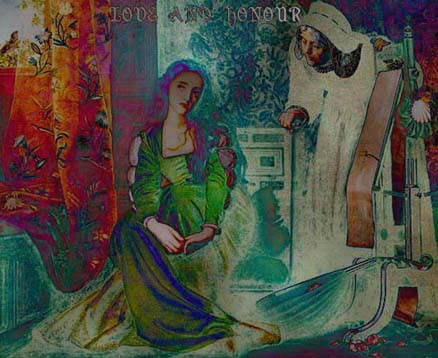
Friendly love can easily gain emotional expression, and the friends can connect mystically via the etheric body. Friendly love can strive for courtly love, a deeply felt, burning love, when friends enter together all five bodies. When Spirit participates in this union, the friends can experience the bliss of interconnected chakra systems. Co-creative biology will occur as a cellular merge -- an alchemy, a fusion -- resulting in the creation of an angel. I am speaking from experience, here. In alchemy, this immortal being is called the Divine Child.
The angel connects its loving parents with a sacred cord between them, and the Father-Mother are Divinely Wed and eternally linked in love. The co-creative pair is an archetypal creative force in our universe, and when we fail to make angels we leave unaccomplished a big part of our purpose for being physical. Today, as we enter the new millennium, conditions for courtly love are very promising. Courtly love in the Middle Ages was achievable because of the societal structure. During the early Middle Ages (12th-13th c. CE) love gained an unprecedented ascendancy when mass consciousness collectively agreed that Only Love Counts. This belief system was due, in part, to everyone's observation of the wide-spread forces around them that existed to act in denial of love. Flourishing in the feudal system at all levels, consisting of the militaries, the governments, the churches, and the social forces or class structures, was the not-love value of greed. What it meant was, many people married for reasons other than love. But love will not be denied, and four of the five bodies listed above exist entirely outside the jurisdictional powers of societal forces. Only the physical body can be controlled by external means. The people on the path of love in the Middle Ages found ways where there were no ways to experience each other and the love each had to offer. What was born of it was a whole beautiful system of paths of love connecting hunky knights to fair ladies and men to women in ways they never dreamed possible. Being physically separated by so many forces, they joined together their minds, their spirits, their emotions, their etheric selves, and often their bodies in the ultimate, consummating act of physical love. (A crime designated F.or U.nlawful C.arnal K.nowledge, sometimes punishable by death.) Nevertheless, it was triumphant and unstoppable. It gave us King Arthur and the Knights of the Round Table in search of the Holy Grail in the magical land of Camelot. And that is what they did there and then, they came a lot, causing the kundalini serpent energy to soar like a hawk because their love found free expression in all five bodies, and one after another the ladies and their knights created angels and found the Grail.
The Town, the Garden, the Castle
The energies, once awakened, would like to rise up and move to the
next energy center but they can't because three portals must first be opened.
The portals are entrances into the body's subtle nervous system, comprised
of a tri-fold energy relationship: ida, channel for energies associated
with mortality; pingala, channel for energies associated with immortality;
and shushumna, a mix of both. Until the portals are opened, the energies
remain in chakra 1, where they express as a co-creative pair existing in
all potential. An expression of this chakra energy with its tri-fold energy
relationship can be seen in the Grail legend and the story of Sir Geraint,
Son of Erbin. In this story, with its serpent-bird kundalini imagery, Sir
Geraint strives to become Knight of the Sparrow-Hawk – all in the name
of Love. The story begins when
King Arthur in the land of Camelot gives a hunt for all his knights. His
Queen Guinevere and the knight Sir Geraint both separately oversleep. Arriving
late to the hunt, they meet each other along the way and ride together,
chatting and just getting to know each other better. The Queen is wearing
a sea-green gown with a gold belt, her hair enmeshed in gold net. As they
ride along on horseback, accompanied by the Queen's maiden in attendance,
a small company of riders comes the other way along the wooded road. The
riders are a dwarf, a lady, and a knight. The lady is dressed all in scarlet,
the knight is wearing armor, and the dwarf is clad in green and perched
atop a very tall horse. As the dwarf trots by, he gives Sir Geraint a dirty
look.
The Queen sends her maiden to find out the name of the knight and the
lady, but the dwarf turns the maiden's horse around and nearly knocks her
from the saddle. The Queen sends Geraint to learn the name of the lady
and the knight, but the dwarf superimposes himself between them and attacks
Geraint with a whip, striking him across the face and leaving a bloody
wound. The Queen tells Geraint to just forget about it, but Geraint says
his curiosity is peaked, and while he feels no ill will toward the dwarf,
he really wants to know who the knight and the lady are. Asking permission
of Queen Guinevere to leave, he rides off after them.
Following after the dwarf, the lady and the knight, Sir Geraint comes to
a high ridge looking down upon a picturesque valley, so tiny and beautiful
as to be held in the palm of his hand. Then, after awhile, he leaves the
ridge and enters a woodland filled with trees and leaves and birds singing.
Next, he rides along a silvery river of reflective water, along farm houses
and farmers tilling the fields, beside cows and sheep and all manner of
country livelihood. The entire day passes and finally they enter a town.
When the dwarf, the lady and the knight ride into the town, all the
people begin cheering and waving, so happy they are. Geraint inquires of
a young man standing near him, "What is all this cheering about?" The man
responds, "The Sparrow-Hawk!" Geraint rides on and meets with another man,
asking him the same question and getting the same answer, "The Sparrow-Hawk!"
Geraint rides on and meets another man who tells him the same thing. Geraint
pulls that man up by his collar and says, "Explain Sparrow-Hawk." The man
points to the mysterious knight and tells Geraint, "That man is Knight
of the Sparrow-Hawk, a great champion knight. Tomorrow he will fight any
man who comes against him." The man tells Geraint, "If you wish to joust
with him, follow him to that ruined castle where they will give you lodgings."
Geraint rides toward the castle.
The old man introduces her as his daughter, the Lady Enid. He explains
to Geraint their dire circumstances, how his bad, younger brother has taken
from him his castle, his wealth and his title of Earl, driving them into the brother's
ruined castle, while the brother lives in the old man's castle in all splendor
as Earl. The old Earl and his daughter have no servants, they are too poor.
The bad brother was of the mind to assemble a court of worthy knights,
so he fashioned a sparrow-hawk of pure silver mounted atop a silver staff.
The knights come jousting for the sparrow-hawk, and whoever wins the joust
keeps the sparrow-hawk for 3 years and becomes Knight of the Sparrow-Hawk.
Geraint tells the old man, "Get me some armor and send it to my room. Tomorrow
I will ride against the Knight of the Sparrow-Hawk."
The old man offers Geraint his own suit of armor. Geraint accepts and
tells him he has only one other request, that the Lady Enid accept him
as her knight. The old man replies, "Ask her yourself," and then departs.
Geraint and the Lady Enid enter the castle garden where Geraint tells her
he is a knight of King Arthur's Round Table and of his Court. He tells
her he is 40 years old, much older than she, and that he has no lady whom
he considers as the lady of his heart, but if she will accept him as her
knight he will endeavor to bring her honor.
Lady Enid gazes with new eyes upon Geraint and feels a stirring in her
heart. She tells him, lowering her eyes, that because of her lack of money and old clothes and
poor estate, she does not deserve such a knight.
Geraint feels the energy of love and vows his loyalty to her, saying none
of it makes any difference, the only thing that really matters is what
is in the heart. Only love counts, he tells her. He asks her again to accept
him, and she replies, yes, he can be her true and faithful knight. He asks
her for her belt from her waist, saying he wants to wear it into the joust.
She gives him her belt of blue leather and Geraint, gazing upon her beauty,
wraps her belt around his arm, like shakti wrapped 3-1/2 times around lingam. On the
path of love they walk hand in hand out of the garden, into the castle
and into the love energy of chakra 3.
The female and male energies once awakened in chakra 1 pass through
the portals to ida and pingala, the subtle nervous system of the body.
The energy differentiates according to mortal and immortal, setting up
a dually powered system of existence that strives for grounding and transcendence
at the same time. When it is realized that the energies are two aspects
of the same consciousness, symbolized by the action of Geraint when he
wraps Enid's belt around his arm, like shakti wrapped around lingam, then
the portal to shushumna will open and kundalini will pass through; and
the door to the castle will open and Geraint and Enid will pass through.
A transcendence has occurred.
When kundalini passes through shushumna to chakra 2, the chakra of
sexuality, and then to chakra 3, an alchemy of love is the result. Chakra
3 is the chakra with guts, an outwardly power-dominated chakra with the
energy of aggression, responsibility and duty towards society and its systems.
It is love turned inside out, it is Shiva going into battle on behalf of
Shakti. Just then, in the distance come 4 riders: the old Earl wearing worn-out
black clothing, Sir Geraint in the Earl's old battered armor, and behind
them beautiful Lady Enid and her mother, the Countess. Seeing Geraint's
armor, the crowd hoots and roars with laughter as he approaches the young
Earl for permission to do battle. The Earl gives his consent and Geraint
rides across the meadow to the knight's pavilion and throws his spear into
the knight's shield so hard it rings like a bell. The knight comes out
of his pavilion and calls Geraint a fool. Geraint responds the knight will
this day make amends for the rudeness of his dwarf towards the Queen's
maiden.
The knight puts on his helmet as Geraint rides back to the Earl's stand.
The knight follows, glorious in his splendid armor, his shield emblazoned
with a silver sparrow-hawk, also his crest upon his helmet, wreathed with
a thin silver scarf. The crowd applauds the splendor of his appearance
and laughs at Geraint in his ancient armor, looking like he has just stepped
out of an old painting.
The excited crowd calls out, "Who is this knight in old armor? Is he
Sir Lancelot of the Lake? Who is he?" As the crowd roars, the knight leaps
to his feet and draws his sword, calling out to Geraint, "Come down here
and face me on foot! I've still got my sword!" The crowd cries out, "Get
off your horse and fight him on foot!"
Sir Geraint leaps down from his horse and draws his sword. With his
shield before him, he approaches the knight, then suddenly they spring
together like two wild bulls bashing into each other, now hacking away
at each other with swords, until a dust cloud surrounds them and no one
can tell who is winning. Geraint grows very angry as the knight withstands
all his smashing blows, and he smashes away at the knight ever harder.
The knight begins to weaken and drops his shield a little.
Geraint lets loose a blow so heavy upon the knight's shield, it knocks
it down to the ground. Then Geraint hits the knight so hard on top of his
helmet, a direct hit on the crown chakra (the entrance/exit point of power),
that the blade cuts straight through and into the bone.
The
knight begs for his life and Geraint agrees to spare him, if he will tell
him his name. The knight responds, "My name is Sir Gaudeamus of the Moors." Geraint says Sir Gaudeamus must do one other thing, and he will let him
live. He must promise to take his dwarf and go to Camelot, where the dwarf
will apologize to the Queen's maiden for his roughness toward her. The
knight promises to do it, and Geraint says, "Arise, Sir Gaudeamus, for
I spare thee."
A herald from the Earl arrives onto the field, saying the Earl requests
his presence. "Take me to him," Geraint says, and follows the herald until
he stands face to face with the Earl, and the Earl asks Geraint his name.
"I am called Geraint. I am the son of the King of Erbin. I am a Knight
of King Arthur's Court and of his Round Table." The Earl, quite impressed,
invites Geraint to supper, but Geraint replies he will not dine with the
Earl until he knows by what right the Earl claims his title. The Earl responds
he will explain everything and invites the old Earl, his wife and daughter
to come to supper. Geraint agrees to this.
Geraint sits at the right hand of the young Earl, and to the Earl's left
sits the old Earl. Beside the old Earl sits his wife, the Countess, and
beside her and far from Geraint sits Lady Enid. Geraint asks the young
Earl to explain by what right he claims the Earldom. The young Earl tells
Geraint what happened when his father died, how he left the big castle
and the town to his older brother, and to him the father left the ruined
castle. The older brother did nothing on behalf of the town, did not set
up justice, did not regulate laws, but just stayed home in the castle,
content with domestic life. The people of the town began to appeal to the
younger brother for all these things, and he responded to their needs.
This went on for several years and then finally, the townspeople rose
up and drove the old Earl, his wife and daughter from the good castle into
the ruined castle, and installed the young Earl in the good castle. Geraint
is surprised to hear this and asks the old Earl, "Is this true?" The old
man says, yes.
Then Geraint, as Knight of the Round Table, lays down the law and all
must obey. He tells the young Earl he must, from this day on, give the
old Earl one-half the money receipts from the town so the old Earl can
live according to his status. Geraint also proclaims the Earl of the town
has the right to name his successor. Everyone agrees to these laws and
the supper is successful. Geraint stays on for several days, during which
time he sees much of Enid and falls deeper in love with her.
Before the marriage, the young Earl offers to give Lady Enid a gold
robe to wear, but Geraint declines graciously, saying he wants Enid to
wear that blue dress she was wearing the first time he saw her. He tells
the Earl he plans to take her to Camelot and present her to Queen Guinevere,
whom he hopes will give Enid the proper clothing to wear. Geraint and Enid
are married, and the following morning Geraint seats Enid in front of him
on his saddle and they gallop toward Camelot.
Only three days have passed since the Queen and Geraint rode together
that fateful day. And this day, as the Queen is out riding with her maiden,
she sees coming toward her a group of people carrying a litter bearing
a wounded knight. The knight's horse follows behind carrying the bright
and shiny armor and led by an esquire. Behind the horse is a lady dressed
in scarlet and riding a white horse, and behind her is a dwarf. The Queen
thinks, "I've seen this group before." She turns to her maiden and asks,
"Is that the dwarf that nearly pushed you off your horse?" The maiden says,
the very one. The Queen says, "I think this knight has met with Sir Geraint
and has something to tell me."
They ride forward to meet the knight, and the Queen inquires after his
condition. The knight says, "Lady, I am a knight who has suffered in battle.
Please tell me where I can find Queen Guinevere?"I am Guinevere," she
replies. "Is this the truth?" the knight asks. "It is," says the Queen.
The knight tells her, "I have been sent by Sir Geraint, who overthrew me
in battle, to tell you my name is Sir Gaudeamus of the Moors, and to find
the maiden to whom my dwarf was rude." The Queen points to the maiden,
"This is she." Sir Gaudeamus says to the maiden, "Fair damsel, I ask pardon
for the rudeness of my dwarf and that you will forgive him." The heart
of the Queen is moved by the knight's apology and she tells him he and
his dwarf are forgiven, and she invites him to the castle where the doctors
can cure him.
Sir Gaudeamus is attended by the king's physicians, and three or four
days pass. One morning Queen Guinevere looks out her bower window and sees
a knight riding toward the castle. And sitting before him on his horse,
she sees a fair lady with blonde hair and dressed in blue. She calls to
her maiden, "Who is that knight?" The maiden says, "I think it is Sir Geraint."
The Queen says, "Yes, it is Geraint!" So they run down to meet them at
the gateway of the castle. The Queen says to Geraint, "Sir, who is that
lady who rides with you?" Geraint says, "She is my wife. I have brought
her here dressed in blue as I first saw her. I hope you will clothe her
as befits her estate as the daughter of an earl, the lady of a knight-royal,
and as my wife."
The Queen says, "Welcome, welcome, Lady! Welcome to Camelot!" She assists
Enid from her horse and takes her to the Queen's bower where she gives
her the richest robes she can find. Enid's face shines with happiness from
out of her dress of silver and gold, and thus did Sir Geraint, Son of Erbin
bring his lady the Fair Enid to the Court of King Arthur in Camelot.
Somewhat surprising it was when Geraint informed the Knight of the
Sparrow-Hawk he would this day fight for his servant's discourtesy to the
Queen's maiden, considering all that had happened after that. This points
to the philosophy of a priori, or primary boundaries, that everything
that happens is bounded by a law of physics antecedent to all our experience,
and the dwarf's action toward the maiden symbolizes this. First, there
is this action and then everything proceeds from it, as in, first, there
is this dimension of space-time and then all our experience proceeds from
it. This concept is expressed by the Muslim word Kaaba and also by Black
Cube of Mecca, both references to the Holy Grail. Kaaba means Cubic House
and refers to our dual condition, that we are bounded by the laws of third
dimensional physics, creating a physical body enclosure like a cubic house
and a mind limited in thinking by the same laws that limit the body.
But we know there is much, much more to existence beyond our world
of illusion. We can begin to access this otherworld sensory experience
and break the boundaries of our a priori condition by grounding and then
opening, symbolized by Geraint's action when he first grounded the Knight
of the Sparrow-Hawk, driving the knight's shield into the ground, and then
opened him at the crown chakra by driving his sword into this head. First
ground then open, a circuitry-creating process that obeys our local laws
of physics and invites the transcendency of these laws. Certainly, Geraint's
methods worked because next we see the defeated knight being taken into
the magical land of Camelot by the Queen herself and being cared for by
the King's own physicians.
Sir Geraint gallantly survives the joust and now embarks on love's
journey as he marries Enid within three days of having first seen her.
But where will the love energy reside next? Chakra 4 at the heart, where
a spiritual love can emerge, chakra 2 sexuality, where a sexual love can
develop, chakra 5 at the throat, expressed as the language of love? Sometimes,
when kundalini moves too fast, when marriages are hastily made and the
bride and groom rush along the path of love, sequential chakras are opened
rapidly and total confusion can be the result. When the kundalini serpent
strikes this way, the wide-range of emotions experienced can be bewildering,
and we begin to experience, then reject, all of our less-than-eternal emotions
built up over a lifetime. In all the confusion, we can experience this
as a rejection of self, with various destructive actions proceeding from
it. This is the traumatic love journey Sir Geraint has now embarked upon. We each of us live in five bodies: spiritual, mental, physical, emotional and mystical. The energy of love passes through our bodies, is transformed and gains a variety of expression. Friendly love between a man and a woman, for example, is a very fluid love, the love and confidences exchanged between friends. It can pass through the spiritual body and became a sacred order of love, or it can pass through the physical body and gain a sexual expression of a high order.
THE KNIGHT OF THE SPARROW HAWK
 The path of love is the path of shakti, the feminine energy of love
waiting at the base of the spine. Shakti is kundalin, meaning "coiled up."
This love energy in a spiral is a symbolic female sex organ coiled 3-1/2
times around lingam, a symbolic male sex organ. In a woman, kundalini shakti
awaits the awakening of the masculine energy of love. In a man, the masculine
energy awaits the awakening of shakti. In both cases, what results from
the awakening is a renewed awareness of the spiritual self and accompanying
transformational love. An alchemy has occurred.
The path of love is the path of shakti, the feminine energy of love
waiting at the base of the spine. Shakti is kundalin, meaning "coiled up."
This love energy in a spiral is a symbolic female sex organ coiled 3-1/2
times around lingam, a symbolic male sex organ. In a woman, kundalini shakti
awaits the awakening of the masculine energy of love. In a man, the masculine
energy awaits the awakening of shakti. In both cases, what results from
the awakening is a renewed awareness of the spiritual self and accompanying
transformational love. An alchemy has occurred.
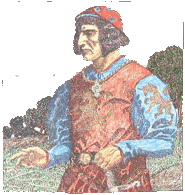 An old man with white hair walks along the parapet of the wall of the
castle. Seeing Geraint and recognizing him as a Knight of the Round Table,
he meets him at the gate and lets him into the castle grounds. The old
man is noble and lordly in demeanor, but poor in appearance and dressed
all in gray garments, worn and threadbare. Welcoming the knight, he takes
Geraint's horse by the bridle and leads him into the courtyard of the castle.
He whistles loud, and from out of a side door of the castle steps the lady
who accompanied the Knight of the Sparrow-Hawk. She is a vision in a blue
gown and blue belt, her hair unadorned, and Geraint gazes upon her searchingly.
She appears to him as a most beautiful woman. She has come to groom and
stable his horse. Geraint protests.
An old man with white hair walks along the parapet of the wall of the
castle. Seeing Geraint and recognizing him as a Knight of the Round Table,
he meets him at the gate and lets him into the castle grounds. The old
man is noble and lordly in demeanor, but poor in appearance and dressed
all in gray garments, worn and threadbare. Welcoming the knight, he takes
Geraint's horse by the bridle and leads him into the courtyard of the castle.
He whistles loud, and from out of a side door of the castle steps the lady
who accompanied the Knight of the Sparrow-Hawk. She is a vision in a blue
gown and blue belt, her hair unadorned, and Geraint gazes upon her searchingly.
She appears to him as a most beautiful woman. She has come to groom and
stable his horse. Geraint protests.
SIR GERAINT AND THE KNIGHT OF THE SPARROW HAWK
 On a green and level field below town, the Knight of the Sparrow-Hawk defeats his opponents one after
another before a large crowd. A high seat is arranged for the Earl and
his court, the seat hung with crimson cloth embroidered with silver gryphons.
On the edge of the field is the silver sparrow-hawk guarded by six esquires
dressed in crimson embroidered with silver gryphons. The sparrow-hawk,
shimmering silver in the sunlight, is set upon a cross-bar of pure silver
and supported by a silver rod thrust into the dirt. With no new opponents
arriving, the knight returns to his pavilion until noon, at which time
he will be awarded the silver sparrow-hawk. The crowd grows restless.
On a green and level field below town, the Knight of the Sparrow-Hawk defeats his opponents one after
another before a large crowd. A high seat is arranged for the Earl and
his court, the seat hung with crimson cloth embroidered with silver gryphons.
On the edge of the field is the silver sparrow-hawk guarded by six esquires
dressed in crimson embroidered with silver gryphons. The sparrow-hawk,
shimmering silver in the sunlight, is set upon a cross-bar of pure silver
and supported by a silver rod thrust into the dirt. With no new opponents
arriving, the knight returns to his pavilion until noon, at which time
he will be awarded the silver sparrow-hawk. The crowd grows restless.
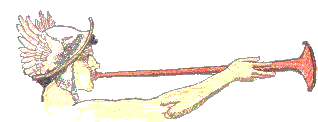 The knights face each other as the trumpets sound, and they rush towards
each other, the horses hooves trampling like thunder, and they crash together
in the middle of the field with a loud roar and the sound of a splintering
lance. It is the knight's lance, splintered into 20 pieces. The lance of
Sir Geraint has held and pierced the shield of the knight, lifting him
out of his saddle and throwing him onto the ground with great force, causing
him to roll over and over.
The knights face each other as the trumpets sound, and they rush towards
each other, the horses hooves trampling like thunder, and they crash together
in the middle of the field with a loud roar and the sound of a splintering
lance. It is the knight's lance, splintered into 20 pieces. The lance of
Sir Geraint has held and pierced the shield of the knight, lifting him
out of his saddle and throwing him onto the ground with great force, causing
him to roll over and over.
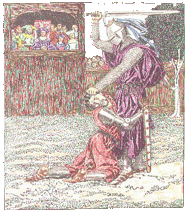 With
that blow the Knight of the Sparrow-Hawk falls to his knees, catching hold
of Geraint's legs. Geraint snatches the knight's helmet from his head,
grabs his hair and pulls his neck forward as if to chop off his head.
With
that blow the Knight of the Sparrow-Hawk falls to his knees, catching hold
of Geraint's legs. Geraint snatches the knight's helmet from his head,
grabs his hair and pulls his neck forward as if to chop off his head.
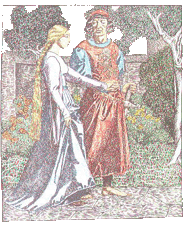 One day,
as they are walking in the garden, Geraint tells Enid he has seen many
fair ladies in his life, but she is by far the most dear to his heart.
Then he asks her if she looks upon him with favor. She tells him, "With
great favor." He asks her, "Will you be my wife?" She tells Geraint, "If
you so desire it I will gladly marry you and go with you wherever you want
to go, because I think only of you, now." Then Sir Geraint kisses her and
they are engaged to marry.
One day,
as they are walking in the garden, Geraint tells Enid he has seen many
fair ladies in his life, but she is by far the most dear to his heart.
Then he asks her if she looks upon him with favor. She tells him, "With
great favor." He asks her, "Will you be my wife?" She tells Geraint, "If
you so desire it I will gladly marry you and go with you wherever you want
to go, because I think only of you, now." Then Sir Geraint kisses her and
they are engaged to marry.
SIR GERAINT AND LADY ENID
When a man marries a woman
half his age he often does not think and love as she thinks and loves,
and she often does not think and love as he thinks and loves. Sir Geraint
is of a serious mind, as becomes his station in life and his years, while
Lady Enid is gay and lively as become her years. Many of her sports and
pastimes that she enjoys Sir Geraint looks upon remotely and from afar,
and not always with pleasure.
Lady Enid notices this about him and wonders what is wrong with him.
It never occurs to her he could be feeling the strong jealousy of love.
In complete innocence she wonders what she has done to cause him to pull
away from her. One day she sees him sitting and thinking deep thoughts,
gazing out of the window of the King's Castle. Geraint looks out upon the
beautiful view, the winding river like a silver ribbon threading the meadows
and fields, the blue sky above with great white clouds floating by, and
the earth so happy and peaceful. He sees none of it, for his eyes are turned
within upon his own gloom and darkness.
Enid sits on his lap, puts her arms around his neck and interlaces her
fingers. "What's the matter, dear?" she asks. "Are you mad at me?"No,"
he responds, "I am not mad at you. There's nothing wrong with me." Then,
he gives it a second thought and decides to tell her, "I haven't been home
in several years and I am thinking of visiting my old parents. I really
miss them." Enid says, "Great! Let's go!" Geraint says, "Would you like
to? I'll ask the King if we may leave and when he gives his consent, we
will go for a visit."
One
summer morning she awakens early and Sir Geraint lays upon his bed beside
her. It is warm and he throws aside the covers so his great chest and arms
and shoulders are bare to the soft air. She beholds his body, how huge
and mighty he is, how strong and powerful. Then she looks at her own body,
how slender and white, how weak and helpless, and she thinks," Is it true
what they say? Can these weak arms of mine hold this strong man back from
his purpose and ambition in life? It can't be true! There are many knights
who are married to other ladies and they are still noble knights. It must
be my fault if there is something wrong." She sighs deeply and this awakens
Geraint and he lies with his eyes closed. Then Enid whispers to herself,
"It's all my fault and I am not a true, right wife for this noble hero."
Geraint hears these words, how she is no true, right wife to him, and
it seems to him she has just confessed her adultery with Peregrans.
This
is a dagger plunged straight into his heart and he thinks, "I was too late
in taking her away from King Arthur's Court." He opens his eyes and looks
at her in anger, startling her and saying to her, "Get up and get dressed."
She obeys and he dresses himself in his full armor, saying to her, "Follow
me." She asks, "Where are we going?" But he speaks no word. She follows
him down the stairs and across the courtyard to the stables. It is early
morning and the sun has only just arisen. The birds are chirping sweetly
as the river below the castle rushes and roars through the deep and mossy
gorges of green and slimy rocks and stones.
Lady Enid waits as Sir Geraint comes forth from the stable leading two
horses. "Mount your horse, Lady," he says to her, and giving her his hand
he lifts her lightly to her saddle. Then he mounts his horse. He turns
to Enid and says, "Lady, I will this day prove to you the strength and
life have not yet left me, and I am still a strong and able knight as deserves
the love of any woman as I did in my youth. Ride ahead of me and lead the
way and I will follow after you. But under no circumstances are you to
speak a word to me unless I say you can. Just ride straight ahead anywhere
you want to go."
Enid thinks to herself, "Geraint is in great danger. I must warn him
even though he will be angry and chastise me for speaking to him." She
turns her horse around and rides to Geraint. He appears very angry and
says to her, "Lady, what is the matter?" She responds, "Dear husband, do
I have your permission to speak?" Geraint says, "It seems you have given
yourself permission to speak. What do you want to say?" She says, "At the
edge of the thicket are three men intending to do us harm. I overhead them
speak. I thought I had better warn you." Geraint's green eyes take on a
glint as he says, "Lady, perhaps you would not be displeased to see me
fall at the hands of those three men. Nevertheless, I hope I will not fail
in this encounter. Meantime, stay here and consider your disobedience in
speaking to me when I asked you not to." Having admonished her, he closes
and latches his helmet, and with spear in hand he rides forward to the
edge of the woods.
All three of their spears strike
Geraint's shield, but he turns it so that all three were broken into pieces.
His own spear holds and penetrates the shield of one of the men, penetrating
the man's body and lifting him out of his saddle and casting him dead a
spear's length behind his horse. Geraint draws
his shining sword.
He whirls his horse around and with sword in hand he
bears down upon the remaining two villains, rising in his saddle and crying
out, "Hah, villain!" and cutting one down. Then whirling around, he cries
out again, "Hah, villain!" and strikes the other one down with a single
blow of his sword. In that short space of time he changes everything, ridding
the area of these three villains who have for a long time inhabited these
parts.
Sir Geraint wipes the blood from his sword and returns it to its scabbard.
He removes the armor from each of the fallen men, lashes it to the saddles
of the horses, ties all three bridle reins together and returns to Enid,
who watched the battle in both sheer terror and total admiration, and he
hands her the reins of the horses, telling her, "Take these reins and go
ahead of me again. And this time, no matter what, don't speak to me unless
I say you can. I'll forgive you this one time, but not twice." Enid obeys,
taking the reins in her little hands and riding forward, Geraint following
far behind.
About noontime they come to the center of the wood where there is a
sudden turn in the road, leading between two high cliffs. Enid sees, not
far away, four armed and mounted men looking very evil, and she overhears
them say, "Look! Here comes a good prize for us! A beautiful woman, three
sets of fine armor and three horses. All guarded by only one man. Let's
kill him and take whatever we want." Enid thinks to herself, "I have to
tell Geraint, even if he never forgives me. I would rather have him alive
and very mad at me than dead." She turns her horse around and rides back
to Geraint, who is frowning very darkly at her. Enid says to him, "Do I
have your permission to speak?" Bitterly, Geraint says, "It appears you
do not need my permission, Lady. What do you have to say?" Enid says, "Sir,
I have to tell you there are four fully armed men ahead and I heard them
say they intended to kill you and take me and the armor and the horses."
"Is that all you have to tell me?" Geraint asked. "It seems you want to
talk so much, that you will come and tell me anything. Wait here and I
will go forward and clear your path for you."
He closes the visor of his helmet and latches it, sets spurs to his
horse and rides forth to meet his enemies. Suddenly they bear down upon
him, riding two abreast because the road is too narrow for four abreast.
Their spears strike Geraint's shield and break into several pieces, but
his spear does not break. It holds and bursts through the shield, through
the armor, and through the body of one of the men, casting him dead on
the ground. Geraint throws his spear aside and draws his sword, rises in
his saddle and strikes one man so hard a blow that he splits his shield,
his helmet and his head, and the man cries out, "I am dead! I am dead!"
and falls dead.
Enid rides on far ahead of Geraint and she thinks, "Did ever a woman
have such a noble man as I have?" Riding along and exulting in her husband,
she hears the sound of voices in the thickets ahead. "Look! Here comes
a beautiful lady, seven good horses with seven suits of armor, and only
one man to guard all of it. Let us five ambush him and take all these things
for ourselves." Enid thinks, "Even if my husband does what he says he will
do and cuts me down with his sword, what does it matter? I would rather
die by his hands than suffer his anger without his love." So she turns
her horse around and rides back to Geraint and asks him, "Can I speak?"
Geraint says, "Didn't I tell you not to speak to me again?"I have to,"
Enid says. "So it would seem," says Geraint. "Speak since you must." She
tells him, "Sir, ahead are five men lying in ambush for you."Is that
all you have to tell me?" asks Geraint. "Stay here with the horses and
I will go forth and clear your path for you." Enid obeys and Geraint rides
forth.
As he reaches the point of ambush, all of a sudden out jump five men
on horseback. A huge battle ensues, and Enid can't tell what's happening.
Sometimes she sees Geraint and sometimes she doesn't. She sees his sword
flashing like lightning and she hears him utter great and terrible cries
of war. At first there are five men against him, then there are four, then
there are three, then there are two, then there is only one, and he is
begging for his life, "Spare me, spare me!" But Geraint says, "I will not
spare you," and strikes a blow so hard the man is killed instantly. Geraint
wipes his sword, breathing hard this time, and puts it away. He strips
the armor from the men, lashes it to the saddles, ties all five of the
reins together, attaches them to the reins of the other horses, and gives
all twelve to Enid, telling her, "Ride on and do not speak to me again."
Seeing her weariness and feeling sorry for her, Geraint gathers the
leaves together in a sort of bed and spreads his cloak upon them, saying,
"Lie here, Lady, and I will keep watch for the night." Enid lies down upon
the bed of leaves and is sick with weariness. She watches Geraint for a
while, as he stands a little distance from her, and she sees how the silvery
moonlight flashes and sparkles on his armor, she hears the rustling and
stamping of the horses, she hears a distant nightingale singing. All these
things blend together and she sleeps. This is the first day of their journey.
Part 1 - Our Five Bodies | Knight of the Sparrow Hawk Copyright Notice - Disk of the World - Text and images copyrighted March 21, 1993-2023, Claire Grace Watson, B.A., M.S.T., U.S. Copyright and under the Digital Millennium Copyright Act of 1998, All rights reserved.
 Among the young knights at Arthur's court is Sir Peregrans, the son
of King Ludd of Cornwall. This noble young man is full of joy and fun.
He is handsome with broad shoulders, black eyebrows and curly black hair,
and he is always ready for a good time. He and Enid are often together
in company and sports, and though Geraint is too proud to appear to observe
this, he does observe it and is greatly affected by it. Sometimes, he thinks
to himself, "What a pity Enid is stuck with an older man like me when Peregrans
is more suited to her age and temperament." But he never says anything
to Enid about it, he just withdraws within with his aching thoughts.
Among the young knights at Arthur's court is Sir Peregrans, the son
of King Ludd of Cornwall. This noble young man is full of joy and fun.
He is handsome with broad shoulders, black eyebrows and curly black hair,
and he is always ready for a good time. He and Enid are often together
in company and sports, and though Geraint is too proud to appear to observe
this, he does observe it and is greatly affected by it. Sometimes, he thinks
to himself, "What a pity Enid is stuck with an older man like me when Peregrans
is more suited to her age and temperament." But he never says anything
to Enid about it, he just withdraws within with his aching thoughts.
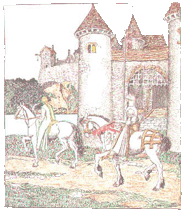 The following day Geraint and Enid leave the Court of King Arthur and
travel with a small party of noble attendants to Amadora, the castle home
of Geraint's parents. After three days of easy riding they arrive and stay
for several months. During that time they participate in hunting, hawking
and jousting, so they are having a fun time and their relationship is developing
trust, love and respect. But the entire time, the townspeople are gossiping
about Geraint, how he does nothing but play at hawking and jousting and
sit with his head upon his wife's knees. Lady Enid hears this gossip and
becomes concerned.
The following day Geraint and Enid leave the Court of King Arthur and
travel with a small party of noble attendants to Amadora, the castle home
of Geraint's parents. After three days of easy riding they arrive and stay
for several months. During that time they participate in hunting, hawking
and jousting, so they are having a fun time and their relationship is developing
trust, love and respect. But the entire time, the townspeople are gossiping
about Geraint, how he does nothing but play at hawking and jousting and
sit with his head upon his wife's knees. Lady Enid hears this gossip and
becomes concerned.
 nid says, "I will do as you say." They ride away from
the castle without anyone knowing they have gone.
Lady Enid rides for several miles with Geraint brooding and following
a considerable distance behind her. About ten o'clock in the morning they
approach a thick dark forest, and as they come close to it Enid sees shining
of armor among the leaves. She sees three men hidden in the thickets and
hears them say to each other, "Look, here's good fortune for us. The knight
appears sturdy enough but he's lost in thought. We can take him three against
one and get his horse, his armor and his lady."
nid says, "I will do as you say." They ride away from
the castle without anyone knowing they have gone.
Lady Enid rides for several miles with Geraint brooding and following
a considerable distance behind her. About ten o'clock in the morning they
approach a thick dark forest, and as they come close to it Enid sees shining
of armor among the leaves. She sees three men hidden in the thickets and
hears them say to each other, "Look, here's good fortune for us. The knight
appears sturdy enough but he's lost in thought. We can take him three against
one and get his horse, his armor and his lady."
 s he rides close to the edge of the woods, all three men come bursting
forth and bear down upon him in full charge, as Geraint drives spurs into
his war-horse and charges against them. They meet head-on, with great violence and a loud
clap of thunder!
s he rides close to the edge of the woods, all three men come bursting
forth and bear down upon him in full charge, as Geraint drives spurs into
his war-horse and charges against them. They meet head-on, with great violence and a loud
clap of thunder!
 eraint whirls around on his horse and sets spurs into its flanks.
He thunders down upon the other two men, who sit stunned at how easily
and quickly this knight has killed their comrades. Geraint rides hard between
them, swinging his sword to the right and to the left, and slicing them
where they sit clean through from the shoulder to the waist. Dismounting
and wiping his sword, Geraint strips them of their armor, lashes it to
their horses and gives the four reins to Enid, telling her, "Observe, please,
that I am still in possession of my knightly manhood despite my advanced
age and lack of pretty youth. Take these four horses together with the
three you already have, and ride on as before. And make sure this time
you do not speak to me unless I say you can. I am very angry from the battle
and in my rage I might cut you down with my sword before I can control
myself." Enid says, "I will do as you say."
eraint whirls around on his horse and sets spurs into its flanks.
He thunders down upon the other two men, who sit stunned at how easily
and quickly this knight has killed their comrades. Geraint rides hard between
them, swinging his sword to the right and to the left, and slicing them
where they sit clean through from the shoulder to the waist. Dismounting
and wiping his sword, Geraint strips them of their armor, lashes it to
their horses and gives the four reins to Enid, telling her, "Observe, please,
that I am still in possession of my knightly manhood despite my advanced
age and lack of pretty youth. Take these four horses together with the
three you already have, and ride on as before. And make sure this time
you do not speak to me unless I say you can. I am very angry from the battle
and in my rage I might cut you down with my sword before I can control
myself." Enid says, "I will do as you say."
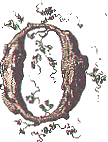 nward they ride through the woods and soon the day begins to draw to a
close and twilight descends. Enid leads the twelve horses with difficulty,
and Geraint observes this and feels sorry for her, but still they ride
on. Then darkness falls and the moon rises, clear and bright and round,
turning everything silver, the treetops, the leaves and the ground. Geraint
tells Enid, "Let's rest here until tomorrow." Enid asks, "Can I speak?"
Geraint say, "Speak." Enid asks, "What will we eat?" Geraint says, "Lady,
it often happens when a knight travels that he goes without food to eat
for the entire day and sometimes even longer than that." Enid falls silent
and sighs, because she is very hungry.
nward they ride through the woods and soon the day begins to draw to a
close and twilight descends. Enid leads the twelve horses with difficulty,
and Geraint observes this and feels sorry for her, but still they ride
on. Then darkness falls and the moon rises, clear and bright and round,
turning everything silver, the treetops, the leaves and the ground. Geraint
tells Enid, "Let's rest here until tomorrow." Enid asks, "Can I speak?"
Geraint say, "Speak." Enid asks, "What will we eat?" Geraint says, "Lady,
it often happens when a knight travels that he goes without food to eat
for the entire day and sometimes even longer than that." Enid falls silent
and sighs, because she is very hungry.
Sir Geraint and the Knight | Geraint and Enid
Page 2 - An Evil Earl | The Little King | The Three Giants
BOOKS, ARTICLES, ART, AND WEB DESIGN BY CLAIRE GRACE WATSONTHIS IS A PHAISTOS DISK INSPIRED ARTICLE